Retargeting Pixels and Consent: GDPR & CCPA
A retargeting pixel drops an advertising identifier the moment it fires, which is exactly what privacy law regulates. Here is how to fire pixels the compliant way under GDPR, ePrivacy, and CCPA.


Why a retargeting pixel is a privacy-law event
The moment a retargeting pixel fires, it drops an advertising cookie or a device identifier and tells an ad network "this exact person was here." That is not a neutral analytics ping. It is the precise activity that GDPR, the ePrivacy Directive, and CCPA were written to govern. If you attach a pixel to a short link and think the redirect somehow sits outside privacy law, you are mistaken: the identifier gets set on the visitor's browser either way, and the law follows the visitor.
What the pixel actually does to the visitor
A pixel is a tiny piece of code that, when loaded, writes an identifier the ad platform can later match to a user profile. That identifier is personal data under GDPR because it can single out an individual across sites. It is a cookie or cookie-equivalent under ePrivacy. And it counts as a "sale" or "share" of personal information under CPRA when you pass it to an ad network for cross-context behavioral advertising. One line of code, three separate legal hooks.
Fires on the redirect, still counts
With Flyn retargeting pixels, the pixel fires on the interstitial served from the flyn.to domain before forwarding to the destination. That is genuinely useful because it lets you retarget on links you do not own. But it does not change your compliance duties. You are still the party choosing to set an advertising identifier on that visitor, so you are still on the hook for a lawful basis and, in the EU and UK, for consent.
The consent gate: how compliant tracking should flow
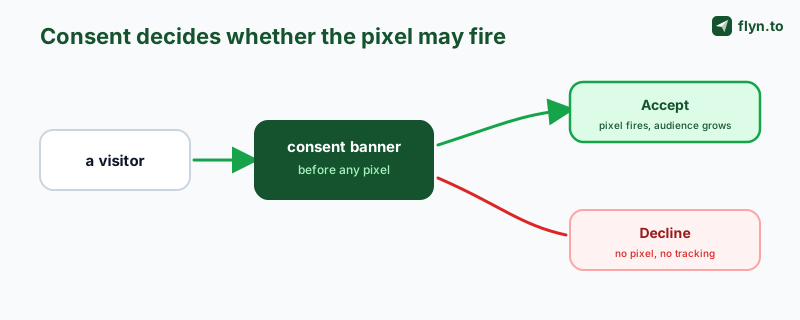
The clean mental model is a gate. Before any pixel loads, the visitor meets a decision point. Accept and the pixel fires, the audience grows, and you can advertise to them later. Decline and nothing tracking-related runs at all. The mistake most people make is firing the pixel first and showing the banner second, which in the EU and UK is exactly backwards.
 Tap to enlarge
Consent has to be a real choice
Under GDPR, consent must be freely given, specific, informed, and unambiguous, and it must be as easy to refuse as to accept. A banner with a giant "Accept" button and a buried "Manage" link fails that test. Pre-ticked boxes fail it. "By using this site you agree" fails it. If you are collecting an email or gating a link at the same time, keep the tracking consent separate from any affiliate disclosure or terms acceptance so consent stays specific.
Withdrawal has to actually work
Consent you cannot withdraw is not consent. Your banner or preference center must let a visitor turn tracking back off later, and when they do, the pixels must stop firing for them. Practically, that means your consent tool needs to gate the pixel on every visit, not just the first one.
Which laws apply, and what each one wants
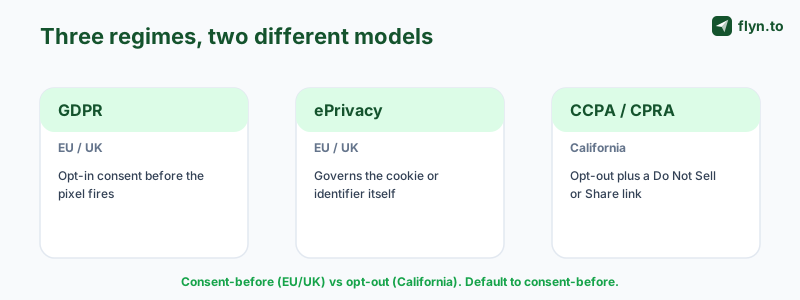
Three regimes cover most of the traffic you will ever pixel. They overlap but they are not the same, and the biggest split is opt-in versus opt-out. Get that split wrong and you are non-compliant in one whole hemisphere of your audience.
 Tap to enlarge
GDPR: the data-protection layer
GDPR (EU) and UK GDPR require a lawful basis to process the personal data a pixel generates. For cross-site advertising, that basis is consent in practice, because legitimate interest is very hard to defend for behavioral ad tracking. GDPR also gives people rights of access and erasure, which is why you keep records of who consented and when.
ePrivacy: the cookie layer
The ePrivacy Directive (the "cookie law") sits on top and governs the act of storing or reading anything on the visitor's device. It requires prior consent for any non-essential cookie or identifier, and a retargeting pixel is the textbook non-essential case. This is the rule that literally forces the pixel to wait for the click.
CCPA and CPRA: the opt-out layer
California flips the model. Under CCPA as amended by CPRA you may fire the pixel by default, but passing identifiers to an ad network counts as a "sale" or "share," so you must give consumers a clear way to opt out. That is the Do Not Sell or Share My Personal Information link, and you must honor the Global Privacy Control signal too.
Side-by-side comparison
| Dimension | GDPR (EU/UK) | ePrivacy (EU/UK) | CCPA/CPRA (California) |
|---|---|---|---|
| Default stance | No processing without lawful basis | No cookie without prior consent | Allowed until the user opts out |
| Consent model | Opt-in | Opt-in | Opt-out |
| When the pixel may fire | After consent | After consent | Immediately, unless opted out |
| Required user control | Withdraw consent, erase data | Refuse or revoke the cookie | Do Not Sell or Share link, honor GPC |
| Who it protects | People in the EU/UK | People in the EU/UK | California residents |
Pixeling on a redirect vs on your own site
People assume that firing a pixel from a short-link redirect is a loophole. It is not. The obligations are identical; only the mechanics of where you place the consent check differ. Understanding that difference keeps you honest.
On your own site: banner sits in front of the page
When the pixel lives on a page you control, your consent manager loads first, holds the pixel, and releases it on accept. This is the standard pattern and the tooling is mature. Your UTM parameters and analytics can coexist with it as long as advertising pixels stay gated.
On a redirect: the interstitial is the moment
With Flyn, the pixel fires on the fast interstitial before forwarding. That is powerful for retargeting affiliate clicks because you never touch the merchant's page. But because you are the one setting the identifier, you still owe EU and UK visitors a consent path. In practice that means directing consented traffic to your pixel-attached short links and keeping a plain, un-pixeled link available where you cannot establish consent.
A short-link redirect does not anonymize anything or move the liability to the destination. If you attach a Meta or TikTok pixel to a link and blast it at EU users with no consent mechanism anywhere in the funnel, you are the controller who set the cookie, and you carry the ePrivacy and GDPR exposure. The redirect changes the plumbing, not the law.
The affiliate and sponsor case
Retargeting a merchant or sponsor link is the most common redirect use case, and it is also where people get sloppy about consent because "it is not my site." Read retargeting links you do not own and the affiliate link tracking guide together: the tracking is yours, so the consent duty is yours.
The five-point compliance checklist
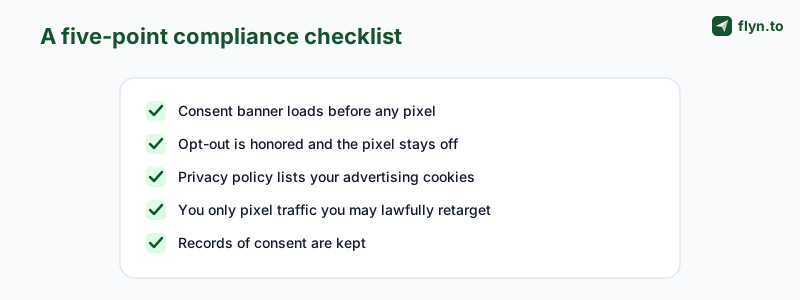
You do not need a law degree to get the basics right. You need a short, honest checklist that you actually run before a campaign goes live. Here is the one we use as a starting point.
 Tap to enlarge
The five checks
- Consent banner loads before any pixel for EU and UK visitors, and holds the pixel until they accept.
- Opt-out is honored for California, with a visible Do Not Sell or Share link and Global Privacy Control support.
- Your privacy policy names the ad cookies and platforms you use, so disclosure is specific, not generic.
- You only pixel lawful, consented traffic, and keep a clean un-pixeled path for everyone else.
- You keep consent records (who, when, what they agreed to) so you can prove it if asked.
Where the platforms fit
All thirteen supported platforms follow the same checklist. Whether you are running TikTok, Pinterest, Reddit, or Facebook campaigns, the pixel is the same kind of advertising identifier and the same five checks apply. The platform-specific setup lives in the Meta guide and the TikTok guide.
Enforcement reality: what actually happens
It is easy to treat privacy law as theoretical until a fine lands. The enforcement picture is uneven but real, and the trend is toward more scrutiny of ad tracking specifically, not less. Here is the measured version.
The EU has teeth
GDPR fines can reach the higher of 20 million euros or 4 percent of global annual turnover. In practice, most retargeting-related penalties are far smaller, but data protection authorities have repeatedly gone after cookie banners that fire trackers before consent or make rejection harder than acceptance. The pattern of enforcement targets exactly the shortcuts this guide tells you to avoid.
California enforces through opt-out failures
CCPA and CPRA enforcement has centered on businesses that ignored opt-out requests or failed to honor the Global Privacy Control signal. Statutory penalties run per violation, and "per violation" can multiply fast across an audience. The California Privacy Protection Agency has signaled that ad-tech sharing is a priority.
The realistic risk for a small operator
If you are a solo marketer or small team, your practical risk is less a headline fine and more a platform problem: ad networks can suspend accounts for compliance issues, and a complaint can trigger a review you do not want. Getting the consent gate right also keeps your pixel data clean, which is the point of building an audience with rotated or QR-driven campaigns in the first place. Compliance and data quality pull in the same direction.
Putting it together without a legal team
You can ship compliant retargeting today with a modest setup. The goal is not perfection on day one, it is a defensible, honest configuration that respects the consent split and can be improved over time.
A practical starting stack
- A consent manager that blocks pixels pre-consent for EU and UK visitors.
- A Do Not Sell or Share link and GPC handling for California.
- A privacy policy that lists your ad platforms and cookies by name.
- Pixels attached in Settings, Retargeting Pixels only after the above is live.
Keep the plumbing honest
Use a UTM parser and first-party click data to measure campaigns, and reserve the advertising pixels for consented traffic. When you generate short links for a LinkedIn, Instagram, or Quora campaign, decide up front which links carry pixels and which do not, based on where your audience sits.
The mandatory disclaimer
This is general information, not legal advice. Privacy obligations depend on your jurisdiction, your audience, and your specific data flows, and the law evolves. Treat this guide and the pixel documentation as a starting point, review your own duties under GDPR and applicable US law, and consult a qualified professional for your situation. The Flyn terms also apply. Retargeting pixels are a Pro and Lifetime feature, so once your consent stack is ready, enabling them is a single step. Not sure where to begin? Create an account and set up your first consented pixel.
Frequently Asked Questions
Do retargeting pixels really fall under GDPR?
When exactly is a retargeting pixel allowed to fire under EU law?
How is CCPA different from GDPR for retargeting?
Does firing a pixel on a redirect avoid consent requirements?
What makes a consent banner actually compliant?
Can I use legitimate interest instead of consent for retargeting?
What is the Do Not Sell or Share link and do I need one?
Do I have to name the ad platforms in my privacy policy?
How long should I keep consent records?
Are the penalties for getting this wrong actually enforced?
Does this apply if I only retarget affiliate or sponsor links?
Is this article legal advice I can rely on?
Free tools for this
Three Flyn tools that pair well with the strategy in this article, all free, no signup needed.
Security Headers Checker
Audit HTTP security headers.
Redirect Checker
Trace 301/302 redirect chains.
URL Cleaner
Strip tracking params from any URL.
Keep reading
Three related deep-dives from the Flyn blog.

Are Short Links Safe? How to Check Before You Click
13 min read

Does a Short Link Click Need Cookie Consent? Law by Law
31 min read

Are Geo-Redirects Legal in the EU? Regulation 2018/302
15 min read
Ready to try Flyn?
Free plan includes 25 links/month, full analytics, and access to all 30+ free tools above. No credit card required.
Already a member? Log in
Karan Bhakuni is the founder of Flyn. He writes about branded links, click analytics, and the link-management tooling growth teams and creators actually need, drawn from building Flyn and reading a lot of user feedback.
Find these guides useful? Add Flyn as a preferred source so more of them show up in your Google results.