Free Branded Domain Finder
Type a brand name and get short domain ideas built for branded short links: domain hacks, truncations, and link extensions, each scored for length, sound, and dictation, with real availability from the official registry where one exists.
Every idea is previewed as a real short link, because a domain that looks fine on its own can read badly once a slug sits after the slash.
Not ready to buy a domain? Start shortening for free.
Create Flyn short links today on a free Flyn domain, with a bot-filtered click count on every link, free forever. Sign up and your links are created on flyn.to, and you can move them to your own branded domain later, whenever you register one.
How to Find a Branded Short Domain in 3 Steps
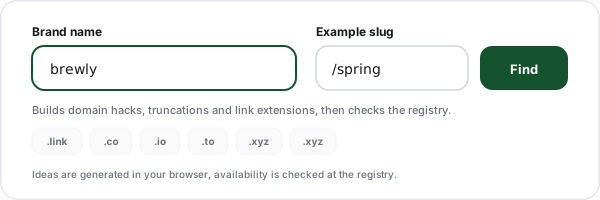
Enter your brand name
Type the brand or product name and an example campaign slug. The name ideas are generated and scored entirely in your browser across five naming patterns. Only the shortlisted candidate domains are then sent to our server, which asks each TLD registry whether that exact name is taken.
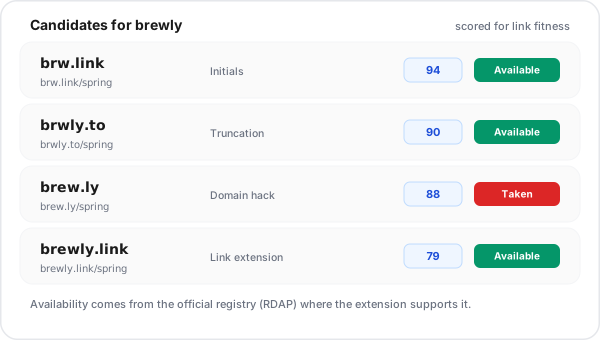
Compare scored candidates
Every idea is grouped by pattern and scored on four signals: total length, spoken syllables, dictation clarity, and how the whole thing reads with a slug after the slash. Every deduction is explained in plain language.
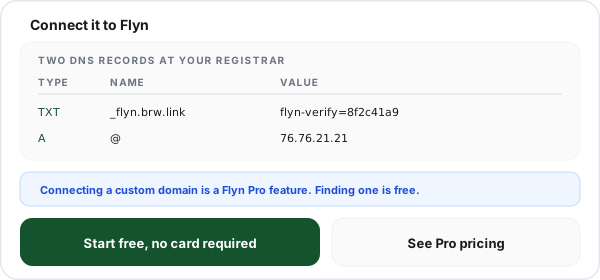
Check availability, then connect it
Candidates on extensions that publish RDAP get a real registry verdict, and extensions that publish nothing are labelled honestly instead of guessed. Register the winner, then point it at Flyn with two DNS records.
What Is a Branded Short Link Domain?
A branded short link domain is a domain you own whose only job is to host redirects. Instead of sharing a generic shortener URL, you share yourbrand.link/spring, and the part of the link a reader actually notices is your name. It is the same idea behind a vanity URL, applied at the domain level rather than the slug level, and it is the single change that makes a short link look deliberate rather than disposable.
Picking one is a different problem from picking a website domain, which is why generic domain generators give unhelpful answers here. A website domain can be twelve or fifteen characters and nobody minds, because people arrive by search or by clicking. A link domain gets typed from a slide, dictated on a call, and printed under a QR code, so length, syllable count, and how it survives being read aloud matter far more than whether it sounds like a startup. That is what this tool optimises for, and it is why every candidate is previewed as a complete short link rather than as a bare domain.
People look for this under a lot of names: a vanity domain finder, a domain hack generator, a short domain name generator, or simply how to pick a short domain. They all describe one job, choosing a custom domain for short links that is short enough to share, clear enough to dictate, and actually free to register. That is the job this page does.
Once you own one, connecting it is a DNS job rather than a migration. Flyn takes a TXT record to verify ownership and a CNAME to route traffic, then provisions the certificate automatically. The full walkthrough is in the custom domain help article, and the feature itself is documented on the custom domains page.
Five Naming Patterns That Produce Short URL Domain Ideas
A general domain generator optimises for a website. A domain name generator for links has a different job, because the result has to survive being typed off a slide and read aloud on a call. So this one does not shuffle a word list: it applies five specific transformations to your brand, labels every result with the pattern that produced it, and lets you filter by pattern so you can compare like with like.
Domain hack
rebrand.ly, from "rebrandly"
The last letters of the brand become the extension, so the word finishes after the dot. Shortest possible result, but only honest when the ending is a real TLD. This tool refuses to invent one.
Short form
nor.to and nrth.to, from "northwind"
First three to five letters, or the consonant skeleton with the vowels dropped and clipped to four. Reads as an abbreviation of your brand and usually wins the length score outright.
Link extension
northwind.link
The full brand on an extension that reads as a link on sight: .link, .to, .click, .page, .site. Longest of the five patterns but the least ambiguous when spoken.
Prefix and suffix
gonorthwind.to, northwindhq.to
get, try, go, or my in front turns the domain into an instruction. hq, app, or co on the end keeps the brand first. Useful when the bare brand is already taken.
Classic extension
northwind.co, northwind.com
The full brand on the extensions buyers recognise fastest. Often the most expensive and most contested, and half of them cannot be checked automatically.
Best TLDs for Short Links, Compared
The right extension is the one that reads as a link, stays cheap to renew, and does not create a support question every time somebody says it out loud. The verification column is the one most comparison articles leave out: it tells you whether any tool, including this one, can honestly check the name for you.
| Extension | Reads as | Checkable here | Watch out for |
|---|---|---|---|
| .link | Unmistakably a link | Yes, RDAP | Reads as generic rather than premium in some markets |
| .to | A direction, "go to" | Yes, RDAP | Tonga ccTLD, pricing is higher than most gTLDs |
| .click | An instruction | Yes, RDAP | Longer than .to or .ly, so it eats your length budget |
| .page | A destination | Yes, RDAP | HSTS preloaded, so HTTPS is mandatory, which is fine for links |
| .site | A destination | Yes, RDAP | Very cheap first year, check the renewal price carefully |
| .ly | Finishes adverb endings | Yes, RDAP | Libya ccTLD with its own registry policies and pricing |
| .xyz | Neutral and modern | Yes, RDAP | Some corporate spam filters still treat it with suspicion |
| .app | Product focused | Yes, RDAP | HTTPS is enforced at the browser level, no plain HTTP fallback |
| .com | Maximum trust | Yes, RDAP | Short names are almost entirely taken or priced as premiums |
| .co | Company, near .com | No RDAP service | Cannot be machine checked, and a common typo target for .com |
| .io | Technical, developer | No RDAP service | Cannot be machine checked, and among the priciest renewals |
| .me | Personal | No RDAP service | Cannot be machine checked, weaker fit for a company brand |
Verification status reflects whether the registry publishes an RDAP service in IANA's bootstrap directory, checked live on every lookup. Pricing and premium status are set by each registry and registrar and are not shown here, so always confirm both at checkout.
How We Score Short Link Fitness
Four signals, weighted, with every deduction written out in plain language next to the candidate so you can disagree with us on the evidence rather than on a mystery number.
Total length
Character count of the whole domain including the dot and the extension. Six characters or fewer scores full marks and every character after that costs seven points, because the domain is competing with your slug for the same limited space in an SMS or on a printed card.
Spoken syllables
How many syllables the domain takes to say out loud, extension included. One or two is ideal. This is the score that separates a domain that works on a podcast or a stage from one that only works on a screen.
Dictation clarity
Whether someone can type it correctly after hearing it once. A hyphen costs the most at 35 points, then a digit at 25, then a run of four or more consonants, a doubled letter, and spelling traps like ph or kn. Every deduction is shown as a plain sentence next to the candidate.
Reads with a slug
The full preview length once your campaign slug sits after the slash. A domain that looks fine alone can read badly as a real link, which is why the tool shows brand.link/summer-sale rather than just brand.link.
A worked example
Take the brand northwind and the campaign slug summer-sale. All three of these come back in the tool's own shortlist, with the scores below. Three candidates, three very different profiles:
nrth.to/summer-salescores 90 out of 100. Seven characters before the slash and nineteen in total, so it takes the length and slug scores almost outright. It loses on dictation, and the card says why: a run of four consonants has to be spelled out for anyone hearing it once.northwind.to/summer-salescores 76. It is unmistakable when spoken and needs no spelling, but twelve characters before the slash and twenty four in total cost it most of the length score.gonorthwind.to/summer-salescores 66. It reads as an instruction, but the prefix adds two more characters than the bare brand and a fourth syllable, so it loses on both length and sound, which is exactly the sort of trade-off the score is there to make visible.
There is no universally correct winner. If your links are mostly clicked from social posts, take the short one. If they are read out on a podcast or printed on packaging, take the one that survives dictation.
Why "Available" Is the Hardest Word in a Domain Tool
Availability here comes from RDAP, the Registration Data Access Protocol, which is the official ICANN successor to WHOIS. Every TLD that supports it publishes a lookup endpoint, and IANA maintains the directory of those endpoints covering roughly 1,200 extensions. We fetch that directory, cache it, and then query each TLD's own registry directly rather than going through a shared public proxy, because a proxy rate limits a batch of this size long before a registry's own endpoint does, and it puts a third party in the middle of an answer we report as authoritative. An HTTP 200 means the registry holds a record for the name, so it is taken. An HTTP 404 means it holds none.
Here is the trap, and it is the reason most instant domain checkers quietly lie to you. A large number of excellent short link extensions publish no RDAP service at all: .io, .co, .me, .sh, .gg, .be, .it, .ws, and .st among them. If a tool asks a generic endpoint about one of those, it receives a 404 for domains that are definitely registered, and a careless implementation renders that as a green "available" badge. We tested exactly this before building the tool, which is why those extensions land in a separate tier here with a plain label and a link to check them at a registrar. You still get the name idea. You do not get a fake verdict.
Even on extensions we can check, we say "appears available, confirm at your registrar" rather than promising anything. Registry state changes by the second, a name can sit in a pending transaction, and short names on popular extensions are frequently held back as registry premiums with a price in the hundreds or thousands that no availability check will ever reveal. A registrar checkout page is the only place a domain is genuinely yours. Honest labelling is what turns a list of clever names into a usable list of available short domains.
From Brand Name to a Live Branded Link
The finder is step one of four. Here is the whole path, including the parts most guides skip.
- 1
Shortlist three candidates, not one
Take the best domain hack, the best short form, and the best link extension idea. Having three means a premium price or a pending transaction on your favourite does not send you back to the start.
- 2
Confirm price and renewal at a registrar
Search each candidate at your registrar and read the renewal line, not the first year headline. If a name comes back as a registry premium, decide whether the price is worth it before you get attached to it.
- 3
Register it and point it at Flyn
Add the domain in Settings under Domains, create the TXT verification record and the CNAME at your registrar, and click Verify. Flyn issues the SSL certificate for you. Root domains use an A record instead of the CNAME.
- 4
Move your links and keep the analytics running
Create new links on the branded domain and keep counting clicks the way you already do. If you also want to see which of those clicks turned into signups or sales, that is what conversion tracking is for.
The longer version, including how to think about naming before you open a registrar, is in how to choose a branded short domain. For what happens after the domain is live, see the conversion tracking docs and what smart links do.
Common Reasons a Short Domain Idea Fails
Six failures we see repeatedly. Five of them are avoidable in the ten minutes before you buy.
The domain expires and every link dies at once
A short domain is a production dependency. When it lapses, every link ever shared on it stops resolving, including printed QR codes you cannot recall. Put it on auto-renew with a payment method that does not expire, and keep the registrar account tied to a shared mailbox rather than one person.
The renewal price was never checked
First year promotional pricing is standard on the cheapest extensions, and the renewal can be several times higher. Read the renewal line on the checkout page, not the headline price on the search results page.
The name is a registry premium
Short, memorable names on popular extensions are often reserved by the registry and priced in the hundreds or thousands, sometimes with a premium renewal every year afterwards. An availability check says nothing about price, which is why we send you to a registrar to confirm.
It cannot survive being read aloud
Hyphens, digits, and doubled letters all force a follow-up question every time the link is spoken. If your audience ever hears the link rather than reads it, the dictation score matters more than the length score.
It looks like a phishing domain
A brand-adjacent name on an unfamiliar extension can trip spam filters and make cautious recipients hesitate. Keep the domain visibly yours, publish it somewhere on your main site, and use it consistently so people learn to recognise it.
Nobody agreed on who owns the registrar login
Branded domains are frequently bought on a personal card during a launch and forgotten. Record the registrar, the renewal date, and the account owner alongside the campaign plan on day one.
Found a Domain? Here Is What Flyn Does With It
Honest split: this is what stays free forever, and this is what a custom domain unlocks on Pro. No trial timer, no card to start.
Free forever
25 new links a month on flyn.to, a QR code for every link, and link editing on every plan. You never need a domain to start.
Free click counts
Every link counts its clicks at no cost, and that count is already bot-filtered, so a scraper never inflates it. The human versus bot split is an account-wide Traffic Quality card, free on every plan.
Pro: your own domain
Connect up to 3 branded domains with a TXT and CNAME record. SSL is provisioned and renewed for you, and links pick their domain per link.
Pro: routing and attribution
Country routing, iOS and Android device routing with deep links, A/B split tests, password protection, and conversion tracking with server-to-server postbacks.
Pro is $9 a month billed annually, or $12 a month month to month. Lifetime access is $249 once. Full breakdown on the pricing page.
Frequently Asked Questions
What is a branded short domain?
How short should a branded link domain be?
What is the best TLD for short links?
Can this tool tell me if a domain is really available?
Why can you not check .io, .co, or .me availability?
What is a domain hack and should I use one for short links?
How much does a short branded domain cost?
Do branded short links help SEO?
Can I use a subdomain instead of buying a new domain?
How do I connect a branded domain to Flyn?
What happens to my links if I stop paying for the domain?
Should I avoid hyphens and numbers in a short domain?
More Free Link Tools
The rest of the link toolkit. Free, instant, no sign-up required.
Link Inspector
See every hop, header, and final destination behind any short link.
Affiliate Link Checker
Confirm your affiliate tags and click IDs survive the redirect chain.
Postback URL Tester
Fire a server-to-server postback and see exactly what the endpoint received.
Redirect Map Generator
Build a clean old-to-new redirect map before a migration goes live.
URL Expander
Reveal where any shortened link actually goes before you click it.
QR Destination Audit
Check a QR destination is fast, HTTPS, and mobile-ready before you print.
Short Link Safety Checker
Score a short link for redirect and destination risk in one click.
UTM Builder
Build consistent campaign URLs before they ever hit your short domain.
Also useful: bulk URL shortener, link cloaker, redirect checker, or browse all free tools.
Buy the domain. Point it at Flyn.
Register the name at your registrar, add two DNS records, and every link you create can live on it minutes later with SSL handled for you. Start free on flyn.to today and connect the branded domain whenever you are ready.
Setting it up: connect a custom domain · custom domains · help centre