Best Link Shorteners for Affiliate Marketers Who Need Cloaking
Cloaking makes an affiliate link look like yours. It can also void your commission or close your account, depending entirely on the network. Here is which tools can do it, what each charges, and which networks will punish you for it.

What Cloaking Actually Does to a Link
Your affiliate URL is 180 characters of tracking parameters and it looks like spam. Cloaking replaces it with something short on your own domain, and keeps your domain visible in the address bar even after the visitor arrives at the merchant. That last part is what separates cloaking from ordinary shortening, and it is where the trouble starts.
 Tap to enlarge
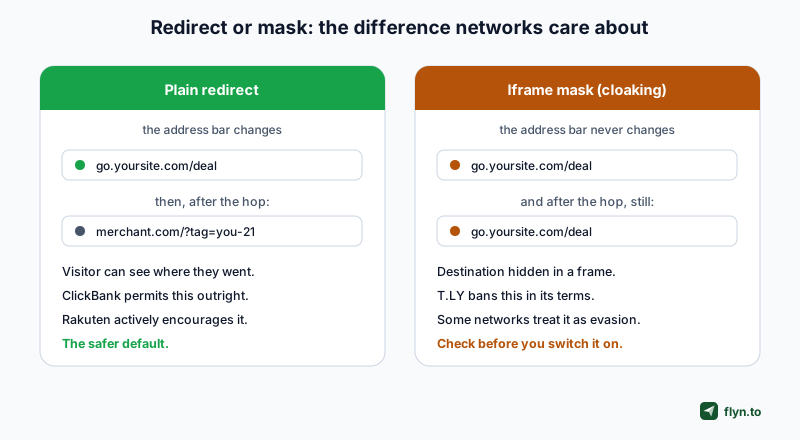
A plain redirect changes the address bar
The visitor clicks go.yoursite.com/deal, the server answers with a redirect, and the browser moves to the merchant. Your branded link did its job and then got out of the way. This is what every shortener does by default, Flyn included.
A mask never lets go
With cloaking on, the destination loads inside a frame and the address bar keeps showing your short URL for the whole visit. The visitor cannot see, copy or bookmark the real destination. That is genuinely useful for protecting an affiliate ID from being stripped, and it is also indistinguishable from the technique used to hide a destination for less honest reasons.
Why the mechanism matters commercially
Because networks write their rules about the mechanism, not the marketing. ClickBank permits shortening a HopLink and draws its line at iframe masking. T.LY bans masking outright in its acceptable-use terms. If you switch cloaking on without reading your network's position, the tool will work perfectly right up until your account does not.
Flyn's cloaking is a full mask with no reveal affordance. We removed the old toolbar that showed a "Open directly" link in July 2026, because that link leaked the real destination and defeated the point. It is effective, which is exactly why the rest of this article is about when not to use it.
Which Shorteners Can Actually Cloak
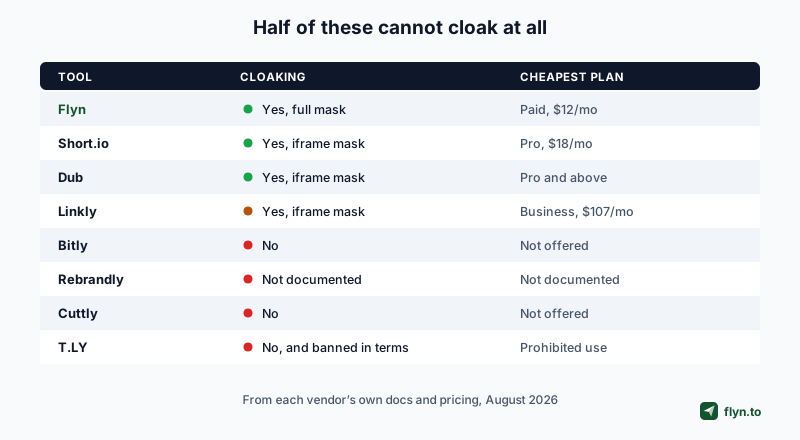
We read each vendor's own documentation and pricing pages in August 2026. Half the field cannot do this at all.
 Tap to enlarge
| Tool | Cloaking | Mechanism | Cheapest plan with it |
|---|---|---|---|
| Flyn | Yes | Full mask, no reveal link | Pro, $12/mo or $9 annual |
| Short.io | Yes | Iframe mask | Pro, $18/mo |
| Dub | Yes | Iframe mask, per link | Pro, $30/mo |
| Linkly | Yes | Iframe mask | Business, $107/mo |
| Bitly | No | 301 redirects only | Not offered |
| Rebrandly | Not documented | n/a | Not documented |
| Cuttly | No | Redirects only | Not offered |
| T.LY | No | Prohibited in its terms | Not available |
Bitly does not cloak, and points the other way
Bitly issues plain redirects and ships a Link Checker that lets anyone preview where a short link goes, which is the opposite posture. Do not be misled by its help article on hiding links: that is about hiding a link from your own dashboard list, not hiding a destination from a visitor.
Rebrandly: absent from the documentation
We could not find cloaking or masking described anywhere on Rebrandly's pricing page, developer docs or support articles. That is not the same as proving the product cannot do it, so the honest phrasing is that Rebrandly does not document it. If you need cloaking, ask them before you subscribe.
The $107 Cloaking Page That Calls Itself Free
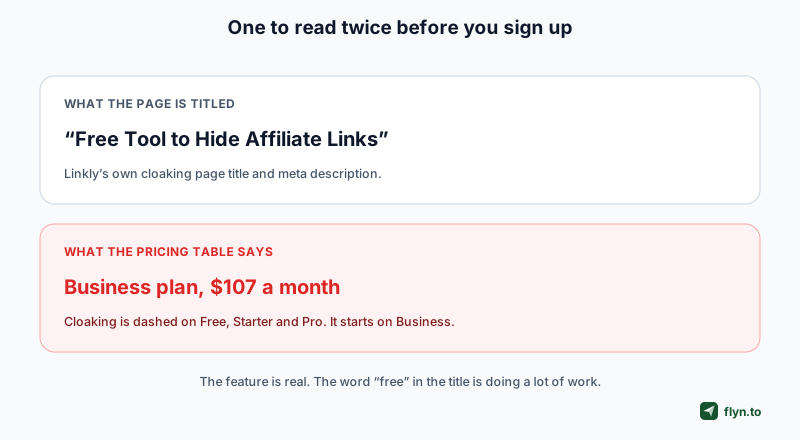
One of these needs calling out on its own, because the gap between the marketing and the paywall is unusually wide.
 Tap to enlarge
Linkly's cloaking page is titled and meta-described as a "Free Tool to Hide Affiliate Links". Its own pricing comparison table dashes link cloaking on Free, Starter and Pro, and ticks it on Business, which is $107 a month billed annually. If you arrive from a search for free affiliate cloaking, you will not discover that until you are several steps in.
This is worth internalising as a general habit rather than a complaint about one vendor. Feature pages are marketing surfaces; the pricing comparison table is the contract. When the two disagree, believe the table.
Before signing up anywhere for cloaking, open the pricing comparison table and find the actual row. If a feature has a dedicated landing page but no row in the table, that is a signal in itself.
The Question That Outranks Which Tool You Pick
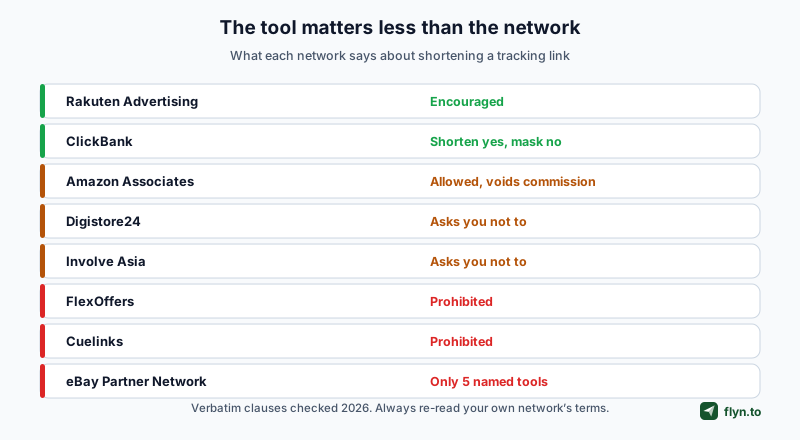
Here is the part most cloaking roundups skip entirely, and it is the part that can cost you money. Your affiliate network has a position on this, it is usually written down, and it overrides whatever your shortener can do.
 Tap to enlarge
| Network | Position on shortening a tracking link | What it means for you |
|---|---|---|
| Rakuten Advertising | Encouraged | Copy the URL into the shortener of your choice |
| ClickBank | Permitted | Shortening yes; the line falls at iframe masking |
| Amazon Associates | Allowed, but voids the commission | Link works, click registers, you are not paid |
| Digistore24 | Asks you not to | Contract silent, help centre discourages it |
| Involve Asia | Asks you not to | Tracking code must stay unaltered |
| FlexOffers | Prohibited | Alteration only via their publisher platform |
| Cuelinks | Prohibited | No external tiny URLs on its Amazon India campaign |
| eBay Partner Network | Five named tools only | ebay.us, Bitly, Ow.ly, Buffer, Geniuslink |
| CJ, Awin, ShareASale, Impact | No rule found | Full public agreements read, nothing either way |
The outright prohibitions
FlexOffers permits links to be altered only through its own publisher platform, with no carve-out for your own domain. Cuelinks is explicit on its Amazon India campaign that any use of tiny URLs or format changes via external tools is prohibited. On both, a cloaked link is a terms breach regardless of which shortener produced it.
eBay names its five approved tools
eBay Partner Network is the strictest and the most specific. Its help centre lists eBay's own ebay.us, Bitly, Ow.ly, Buffer and Geniuslink as "the only ones that are permitted to be used for EPN links", and its agreement's cloaking clause forbids redirecting traffic through middle servers to mask a referring source. Flyn is not on that list. If you promote eBay, use eBay's own ebay.us shortener for EPN links and keep Flyn for every other network.
Amazon's quiet penalty
Amazon Associates permits shortening, and then voids the commission on it. That is worse than a refusal, because the link works, the click registers, and the money simply never arrives. This one catches people for months.
Where it is fine, and even encouraged
Rakuten Advertising tells publishers outright that they can copy a tracking URL into the shortener of their choice, and endorses own-domain redirects as a way past ad blockers. ClickBank answers the question directly in its FAQ and permits shortening or cloaking a HopLink, with the practical line falling at iframe masking. For CJ, Awin, ShareASale and Impact we read the full public agreements and found no rule either way.
The best cloaking tool in the world cannot make a cloaked link compliant with a network that forbids cloaked links. Read the terms first, choose the tool second.
These positions change, and ours is a snapshot. Before you build a campaign on any of them, open your own network's current agreement and search it for "shorten", "cloak" and "mask". If you cannot find a clause, that absence is itself worth a support ticket rather than an assumption.
Cloaking Honestly, and Staying Indexed
Cloaking is not inherently deceptive. Publishers cloak to keep links tidy, to survive a merchant changing its URL structure, and to stop a network's tracking parameters being stripped in transit. The line between that and something Google will penalise is narrower than most guides admit.
Same destination for everyone
Honest cloaking hides a URL. Deceptive cloaking shows different content to a crawler than to a person, which is a distinct practice and a search-guidelines violation. Our link cloaker tool explains the mechanics. If your short link resolves to one place for everyone, you are on the right side of that line.
Disclose the relationship anyway
Hiding the destination does not remove the obligation to say the link is an affiliate link. Our guide to disclosing affiliate links with rel=sponsored covers the FTC side and the markup, and neither is affected by whether the URL is masked.
Do not cloak into a redirect chain
Masking a link that itself redirects two or three more times is what T.LY's terms describe as chained and evasive redirects, and safety systems treat the pattern as a signal. One hop into the merchant is fine; four is asking to be flagged.
Expect masked pages to behave oddly
An iframe mask breaks anything the merchant does that assumes it owns the top-level window, which can include checkout flows, some payment providers and any page sending framebusting headers. Test the full purchase path before you rely on it.
Where Flyn Fits, and Where It Does Not
 Tap to enlarge
If price is the only criterion
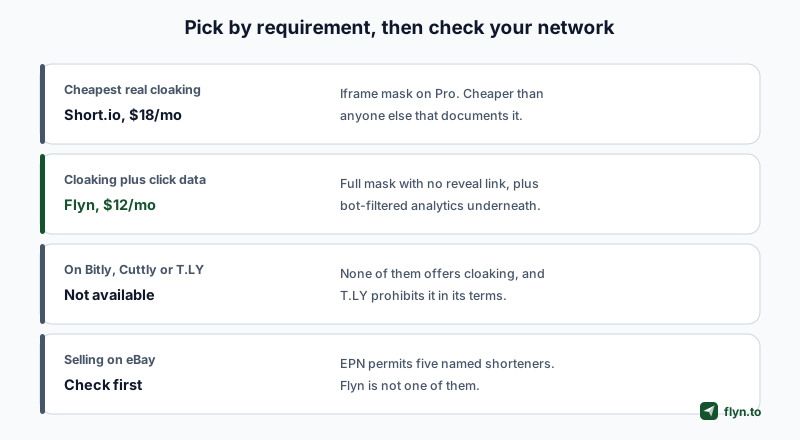
Flyn is the cheapest documented cloaking of the eight: $12/month, or $9 billed annually. Short.io is next at $18/month, or $15 billed annually.
If you want to measure what the cloak hides
This is our actual argument. A masked link still produces click data, and ours arrives with bot traffic filtered and counted separately, so an affiliate campaign's numbers reflect people rather than crawlers. Pair that with weighted rotation across offers and you can see which merchant page earns per real click.
If you promote on eBay
Use eBay's own ebay.us shortener for EPN links, since Flyn is not on eBay's approved list, and keep Flyn for every other network. We are not going to pretend the restriction does not exist.
If you promote on FlexOffers or Cuelinks
Do not shorten the link at all, with us or anyone. The prohibition is on the alteration, not on the brand of shortener.
If you are on Amazon Associates
You can shorten, and you will lose the commission. Use the native SiteStripe short link if you want brevity, and keep branded cloaking for merchants whose terms permit it. Start free if you want to test the flow first. There is more detail in our affiliate link tracking guide.
Setting Up a Cloaked Affiliate Link
The steps are similar across the four tools that support it. Using Flyn as the example.
Use your own domain
Cloaking on a shared domain defeats most of the purpose, because the visitor still sees somebody else's brand. Choosing a branded short domain covers picking one. Connecting it is a paid feature on Flyn, while Short.io, Dub and Linkly each include one on their free plans (their cloaking is still paid).
Create the link, then enable cloaking on it
Paste the full affiliate URL including every tracking parameter, check it with the UTM parser if you are unsure what it carries, set your slug, and switch cloaking on. Do not strip parameters to make the URL tidier; the cloak is what makes it tidy, and the parameters are what pay you.
Test the whole purchase path
Click your own link, complete a test purchase if the merchant allows it, and confirm the sale attributes. A redirect checker shows every hop the link makes. Frame-based masking is exactly where attribution quietly breaks, and finding out in your monthly statement is expensive.
Keep an eye on the click quality
Affiliate links attract bots. If your tool reports filtered click counts, watch the ratio: a sudden swing usually means a scraper found your link, not that your campaign took off. Our guide to cloaking affiliate links without a website walks the whole flow step by step.
Frequently Asked Questions
Which link shorteners support affiliate link cloaking?
Is cloaking affiliate links against the rules?
Does cloaking a link hurt SEO?
Why does Amazon still pay nothing on a shortened link?
What is the difference between shortening and cloaking?
Can I cloak links for free?
Will a masked link break the merchant's checkout?
Which shortener should an affiliate marketer actually use?
Free tools for this
Three Flyn tools that pair well with the strategy in this article, all free, no signup needed.
UTM Builder
Build campaign-tracked URLs in seconds.
Broken Link Checker
Scan any page for dead links and 404s.
Redirect Checker
Trace 301/302 redirect chains.
Keep reading
Three related deep-dives from the Flyn blog.
Best Link Rotators for A/B Testing and Traffic Splitting
16 min read
Best URL Shorteners That Filter Bot Clicks From Analytics
15 min read
URL Shortener Lifetime Deals: What Exists and What to Check
14 min read
Ready to try Flyn?
Free plan includes 25 links/month, full analytics, and access to all 30+ free tools above. No credit card required.
Already a member? Log in
Karan Bhakuni is the founder of Flyn. He writes about branded links, click analytics, and the link-management tooling growth teams and creators actually need, drawn from building Flyn and reading a lot of user feedback.
Find these guides useful? Add Flyn as a preferred source so more of them show up in your Google results.