URL Shortener Lifetime Deals: What Exists and What to Check
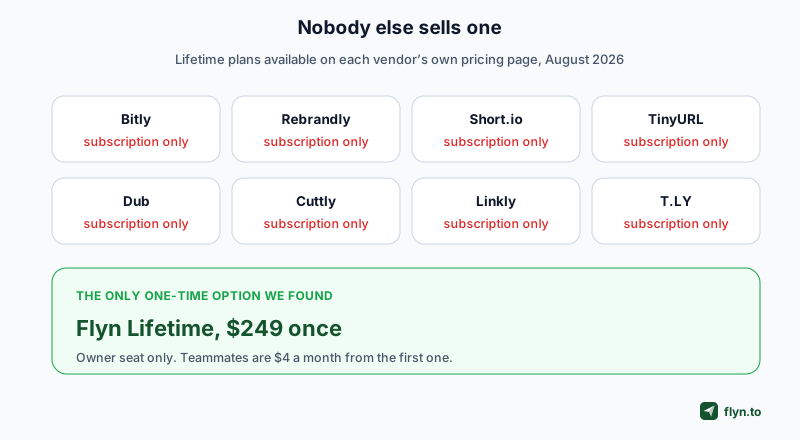
The eight biggest URL shorteners sell subscriptions only. Flyn sells a $249 one-time Lifetime plan directly, and smaller tools turn up on deal marketplaces, so this is less a roundup than a question about whether paying once is a good idea at all.

We Went Looking for Lifetime Deals and Found Almost Nothing
Lifetime deals are common in SaaS. Design tools, writing assistants and project trackers all show up on deal sites with a one-time price. Link shorteners essentially never do, and after checking eight of them we think that is worth explaining rather than glossing over.
 Tap to enlarge
What we checked
Each vendor's own pricing page in August 2026, looking for any one-time payment, perpetual licence or lifetime tier. Every one offered a monthly or annual toggle and nothing else, which our alternatives comparisons reflect. Bitly's billing help even states plainly that self-service plans operate on an auto-renewal basis.
What we did not find
Any evidence of past lifetime campaigns for these vendors either. That matters because deal-aggregator articles frequently describe an expired AppSumo promotion as though it might return. We are not going to claim a deal ended when we cannot show it existed.
Why the category resists it
A shortener carries a cost that never stops. Every redirect is a request someone has to serve, every link is a row someone has to store, and a link created today may still be clicked in ten years. Selling perpetual access to a perpetual cost is genuinely hard arithmetic, which is why most vendors do not try.
This is a snapshot of eight vendors, not the whole market. Smaller shorteners do occasionally run lifetime promotions, and those come with sharper versions of every risk in this article. The checks below apply to any of them.
What Renting Actually Costs
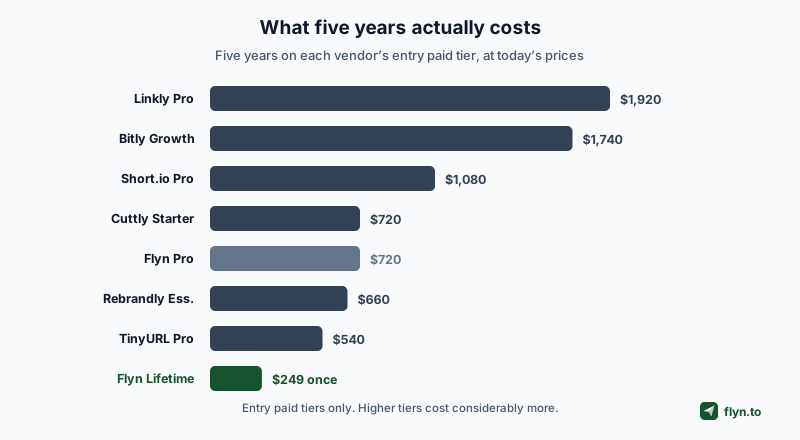
If nobody sells lifetime access, the honest comparison is against what you would otherwise pay over the years you will actually use the tool.
 Tap to enlarge
| Plan | Monthly | 3 years | 5 years |
|---|---|---|---|
| Flyn Lifetime | $249 once | $249 | $249 |
| Flyn Pro | $9 annual, or $12 monthly | $324 ($432 monthly) | $540 ($720 monthly) |
| Linkly Pro | $32 annual | $1,152 | $1,920 |
| Bitly Growth | $29 annual | $1,044 | $1,740 |
| Short.io Pro | $18 | $648 | $1,080 |
| Cuttly Starter | $12 | $432 | $720 |
| Rebrandly Essentials | $11 | $396 | $660 |
| TinyURL Pro | $9 annual | $324 | $540 |
Read the tier, not just the price
These are entry paid tiers and they buy very different things. Flyn Pro at $12, or $9 billed annually, already includes cloaking, weighted rotation and 3 custom domains. Short.io's cloaking starts at $18 on Pro, Bitly Growth at $29 is where branded links start, and Rebrandly Essentials at $11 caps you at 250 links a month. A cheap row here is not a better deal if it excludes the feature you actually need.
The break-even is shorter than people assume
Against Flyn Pro at $12/month, a $249 one-time payment pays for itself in about 21 months. Against the annual rate of $9/month it takes about 28. If you are confident you will still be shortening links in two years, the arithmetic is straightforward. If you are not, it is not.
Five Questions Before Any Lifetime Purchase
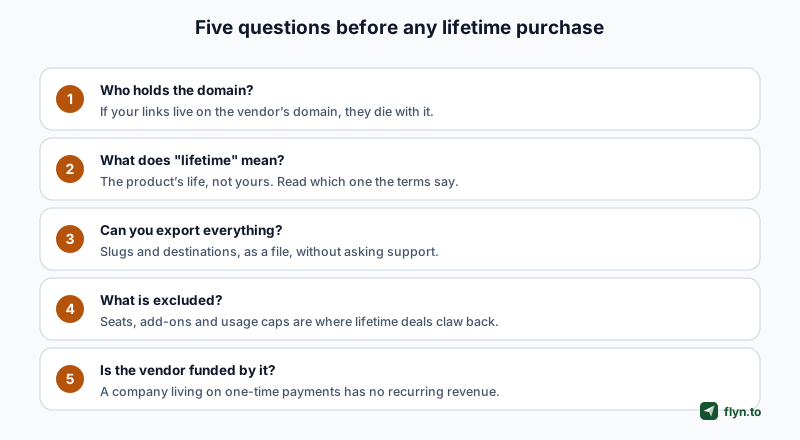
These apply to ours and to anyone else's, and the first one matters more than the other four combined.
 Tap to enlarge
1. Whose domain are your links on?
If your short links live on the vendor's domain, they are only as durable as that vendor. On your own domain, moving is a DNS change. This single decision does more to protect you than any pricing model, which is why choosing a branded short domain is the first thing we would tell anyone buying any plan.
2. Whose lifetime?
Lifetime deals mean the product's lifetime, not yours. That is standard and it is not a trick, but it should be read in the terms rather than assumed.
3. Can you get your data out unaided?
You want an export of slugs and destinations you can trigger yourself, as a file, without opening a support ticket. If the only route out is asking politely, you do not have an exit.
4. What is excluded?
This is where lifetime deals claw value back, and ours is no exception: Flyn's covers the owner seat only. Pro includes two teammates at no extra cost; the Lifetime deal includes none, so every teammate is $4/month from the first. If you are buying for a team, the subscription is genuinely the better product.
5. Is the vendor funded by the deal?
A company whose revenue is mostly one-time payments has no recurring income to pay for the servers your links run on. Ask what proportion of their revenue is recurring. A vendor unwilling to answer has told you something. Our pricing page states ours plainly.
Buy a lifetime deal because the price is good, not because it feels safer. It is not safer. It is just cheaper.
The Risk We Are Not Going to Hide
 Tap to enlarge
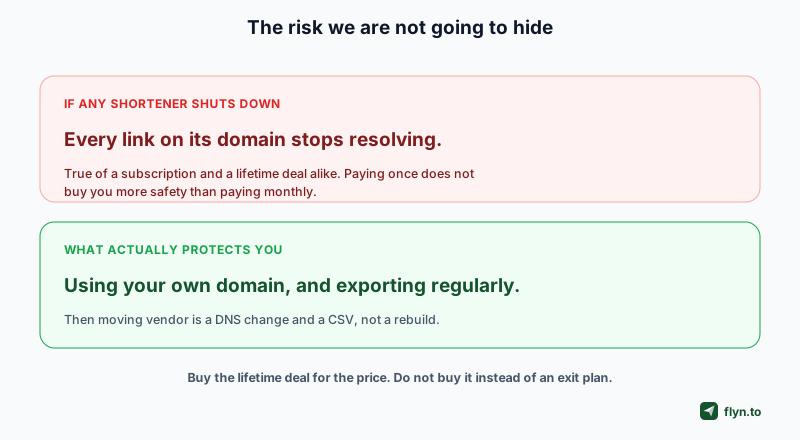
Here is the part a vendor selling a lifetime deal has an obvious incentive to skip. If a shortener shuts down, every link on its domain stops resolving. Not degrades, stops. Anything you printed, posted or embedded becomes a dead end, and no refund reconstructs that.
Paying once does not change that exposure
A monthly subscriber and a lifetime buyer are in exactly the same position on the day a service closes. The lifetime buyer has simply prepaid. So "lifetime" should read as a pricing decision, never as a durability guarantee.
What actually reduces the risk
Two things, neither of which is a plan. Use your own domain, so a migration is a DNS change rather than a rebuild. And export your links on a schedule, so you always hold the mapping of slug to destination. Google's own goo.gl shutdown is the reference case here: the tool was free, enormous, and run by Google, and the links still stopped working. We wrote about what goo.gl users had to do when it happened.
Be especially careful with lifetime deals from very small shorteners on deal marketplaces. The pattern that goes wrong is a vendor funding development by selling perpetual access, then discovering the serving costs never stop. The cheaper the deal, the more carefully you should read question five.
When a Subscription Is Genuinely the Better Buy
 Tap to enlarge
If you need seats
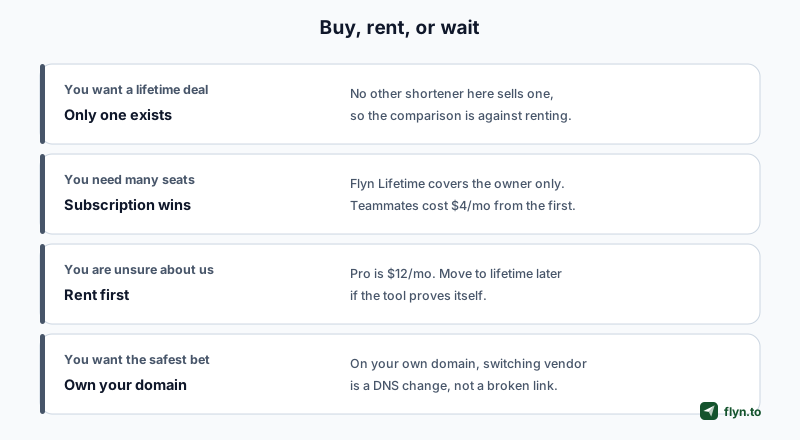
Flyn Pro includes your seat plus two teammates for $12/month. The Lifetime deal includes only the owner, so a team of three costs $249 plus $8/month indefinitely. For any real team, Pro is the better product and we would rather say so than sell the wrong thing.
If you are not sure the tool fits
Rent first. The free plan carries 25 links a month with analytics, and Pro is $12. Moving to lifetime later costs you nothing except the months you paid, and you will know by then whether the tool earns it.
If you need a feature on a higher tier
Check what the lifetime deal actually includes before comparing prices. A cheap perpetual plan that excludes the one capability you need is not cheaper than a subscription that includes it.
If you are buying for a client
Think about who holds the account. A lifetime deal tied to an agency's login becomes awkward the day the client leaves, and awkward is expensive when it involves links in printed material.
The Exit Plan You Should Have Either Way
Whatever you pay, the thing that protects your links is being able to leave. This takes an afternoon to set up and it makes the pricing question much less frightening.
Own the domain the links live on
A short link on your own domain is portable by definition. The slug is yours, the domain is yours, and the vendor is just the thing answering the request. Every tool in this comparison supports custom domains on paid plans, so this is a decision rather than a feature you have to shop for.
Keep an export you did not have to ask for
Trigger it yourself, on a schedule, and store it outside the vendor. Two columns matter above all others: the slug and the destination. Everything else is recoverable; that mapping is not.
| What to keep | Why | How often |
|---|---|---|
| Slug and destination for every link | The one thing that cannot be reconstructed | Monthly, or after any bulk change |
| Your custom domain's DNS access | Repointing is the whole migration | Confirm access quarterly |
| Historical click totals | Analytics rarely survive a move | Before any vendor switch |
| A list of where links are published | Print and embeds cannot be edited later | As you publish |
Know which links you cannot change
Links in printed material, in a video, or embedded in an app release are the ones that hurt. Keep a short list of them, and put those on your own domain without exception. A link you can edit later is a low-stakes decision; a link on a business card is not.
Test the migration once, cheaply
Point a spare subdomain at a second provider, recreate five links, confirm they resolve. Doing this once while nothing is on fire tells you how long a real migration would take, and it usually turns out to be shorter than people fear. Our migration guides cover the vendor-specific steps.
If you are about to buy any lifetime deal, do the export test first. Sign up free, create three links, and try to get them out as a file. If that is awkward on a trial account, it will not be better after you have paid.
How to Evaluate the One That Exists
Since ours is the only lifetime option we found in this comparison, here it is described plainly enough that you can decide against it.
What you pay and what you get
The Lifetime Founder Deal is $249 once, listed against a $499 anchor. It carries the Pro feature set, including unlimited links, custom domains, weighted rotation, cloaking, the API and bot-filtered analytics, plus future Pro features as they ship, including the MCP server and webhooks.
What it does not carry
Team seats. The owner is covered; everyone else is $4/month. If your workspace is three people, price it as $249 plus $96 a year rather than as a flat $249.
The comparison that matters
Against renting Flyn Pro, it breaks even around month 21. Against renting a competitor, it depends entirely on which tier you would have needed. Against not needing a shortener in two years, it is worse than the free plan.
What we would advise
If you already use a shortener weekly and expect to keep doing so, the arithmetic favours buying once. If you are still deciding whether you need one at all, start free and revisit it. Any vendor pushing you to decide today is optimising for their cash flow rather than your outcome.
Frequently Asked Questions
Which URL shorteners offer lifetime deals?
Does Bitly have a lifetime deal?
Is a lifetime deal on a URL shortener safe?
How long does a lifetime deal take to pay for itself?
What is usually excluded from a lifetime deal?
Why are lifetime deals rare for URL shorteners specifically?
Should I buy a lifetime deal or pay monthly?
What happens to my links if the shortener shuts down?
Free tools for this
Three Flyn tools that pair well with the strategy in this article, all free, no signup needed.
UTM Builder
Build campaign-tracked URLs in seconds.
Broken Link Checker
Scan any page for dead links and 404s.
Redirect Checker
Trace 301/302 redirect chains.
Keep reading
Three related deep-dives from the Flyn blog.
Best Link Rotators for A/B Testing and Traffic Splitting
16 min read
Best Link Shorteners for Affiliate Marketers Who Need Cloaking
16 min read
Best URL Shorteners That Filter Bot Clicks From Analytics
15 min read
Ready to try Flyn?
Free plan includes 25 links/month, full analytics, and access to all 30+ free tools above. No credit card required.
Already a member? Log in
Karan Bhakuni is the founder of Flyn. He writes about branded links, click analytics, and the link-management tooling growth teams and creators actually need, drawn from building Flyn and reading a lot of user feedback.
Find these guides useful? Add Flyn as a preferred source so more of them show up in your Google results.