NoFollow vs DoFollow Links: The Complete SEO Guide
Most marketers can define nofollow and dofollow but still get the details wrong, nofollowing internal nav, forgetting sponsored on affiliate links, confusing noopener with SEO. This is the definitive guide that fixes all of it.


NoFollow vs DoFollow: The Core Distinction
The short answer: a dofollow link is a normal link that passes ranking credit (link equity) from your page to the page it points at, and it needs no special markup because it is the default state of every link. A nofollow link adds rel="nofollow", which asks search engines not to pass that credit. Visitors see no difference between the two; the attribute speaks only to crawlers.
If you build links, write content, or run an affiliate site, you have hit this question: should this link be nofollow or dofollow? Most people can recite a one-line definition and still get the practical details wrong, they nofollow their own navigation, forget the sponsored attribute on affiliate links, or assume noopener does something to rankings. This guide fixes every one of those mistakes, with specifics on how Google actually treats each attribute in 2026.
Start with the single fact that clears up most of the confusion: there is no rel="dofollow" attribute. It does not exist in the HTML spec and never has. A "dofollow" link is simply a normal link with no rel annotation telling search engines to treat it differently. When SEOs say "make that a dofollow link," they mean "leave the link plain, don't add nofollow."
What a dofollow link actually is
A dofollow link is the default state of every <a href> tag. It tells search engines two things implicitly: crawl this URL, and let it carry a ranking signal, historically called PageRank, to the destination. Every editorial link, every internal navigation link, and every plain citation you have ever published is a dofollow link unless you went out of your way to change it.
What a nofollow link actually is
A nofollow link carries rel="nofollow" in its markup: <a href="https://example.com" rel="nofollow">. Introduced by Google, Yahoo, and MSN in 2005 to fight comment spam, it was originally a hard instruction: do not pass ranking credit through this link. The attribute is invisible to visitors, it changes nothing about how the link looks or clicks. It only speaks to crawlers. Here is the full set of states a link can be in:
- Dofollow, default, no markup needed, passes link equity.
- Nofollow, explicit
rel="nofollow", signals "I don't vouch for this." - Sponsored, explicit
rel="sponsored", signals a paid or compensated link. - UGC, explicit
rel="ugc", signals user-generated content like a comment.
Here is what each state looks like in real markup. The anchor text and destination are identical in all four rows; only the rel value changes how search engines treat the link:
| Link state | The HTML you write |
|---|---|
| Dofollow (default) | <a href="https://example.com">best running shoes</a> |
| Nofollow | <a href="https://example.com" rel="nofollow">best running shoes</a> |
| Sponsored | <a href="https://example.com" rel="sponsored">best running shoes</a> |
| UGC | <a href="https://example.com" rel="ugc">best running shoes</a> |
The last three are the only annotations that change SEO behavior, and we cover each in depth below. To see how these attributes play out on a real page, scan a competitor URL through the NoFollow Link Checker and watch which links get flagged.
How Link Equity and PageRank Flow
To use these attributes well, you need a working mental model of link equity, the ranking value one page passes to another through a link. It is the whole reason the nofollow/dofollow distinction exists.
The PageRank model in one paragraph
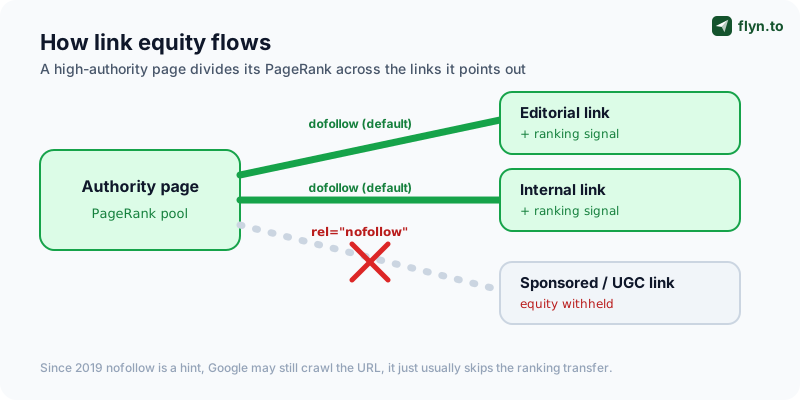
Google's original ranking system, PageRank, treats every link as a vote. A page accumulates authority from the links pointing at it, then passes a share of that authority onward through its own outbound links. A page with high authority and few outbound links passes a large share through each one; a page with low authority and hundreds of outbound links passes very little. Modern Google uses far more than PageRank, but the underlying idea, links transfer ranking value, and a dofollow link is the pipe that value flows through, still holds.
 Tap to enlarge
What nofollow does to the flow, and the sculpting myth
When you add rel="nofollow", you historically told Google: do not send ranking credit down this pipe. That made nofollow useful for two jobs, keeping equity from leaking to spam, and complying with Google's rules on paid links. The destination still receives the click and the referral traffic; it just (usually) does not get the SEO signal.
Years ago, SEOs tried PageRank sculpting, nofollowing low-value internal links so more equity would funnel to important pages. Google killed this in 2009: a nofollowed internal link no longer redirects its share of equity to your other links. The equity allocated to that link simply evaporates. So nofollowing your own internal links does not concentrate authority, it destroys it. Keep this straight when deciding which links to annotate:
- Dofollow internal link, passes equity, helps the target page rank. Keep these.
- Nofollow internal link, passes nothing, and the equity is lost, not redirected. Avoid.
- Dofollow external link, passes equity to another site. Use for trusted sources.
- Nofollow external link, withholds equity. Use for untrusted or paid links.
Want to see how equity moves inside your own site? The Internal Link Checker maps which pages link to which, and the internal linking SEO strategy guide explains how to route that equity to pages that need it.
Google's 2019 Rel Attributes Update
The most important shift in this entire topic happened in September 2019, and a surprising number of marketers still operate on the pre-2019 rules. Google changed two things at once: it added new rel values, and it changed how nofollow is interpreted.
nofollow became a "hint," not a directive
Before 2019, nofollow was a hard directive, Google would not crawl or pass equity through a nofollowed link, full stop. After the update, nofollow is a hint. Google now reserves the right to crawl a nofollowed URL and even use it for ranking purposes if its systems decide that is appropriate. In practice Google still treats most nofollow links as "don't pass equity," but the guarantee is gone. The takeaway: nofollow is no longer a reliable way to keep a page out of Google's index, for that, use noindex or robots rules instead.
The two new values: sponsored and ugc
Google introduced two more specific rel values so site owners could describe why a link should not pass equity. The full matrix now looks like this:
| rel value | Meaning | Passes equity? | Use it for |
|---|---|---|---|
| (none) | Dofollow, the default | Yes | Editorial links, internal navigation, trusted citations |
nofollow | Generic "I don't vouch for this" | No (hint) | Untrusted links, links you can't verify |
sponsored | Paid or compensated placement | No (hint) | Ads, affiliate links, paid reviews, sponsorships |
ugc | User-generated content | No (hint) | Blog comments, forum posts, profile links |
You can also combine values, the rel attribute accepts multiple space-separated entries. A link inside a user comment that you also do not want to vouch for can be rel="ugc nofollow"; an affiliate link in a sponsored post can be rel="sponsored nofollow". Combining is optional, Google says sponsored or ugc alone is enough, but it is harmless.
Google has stated it treats sponsored, ugc, and nofollow almost identically for ranking, all three are hints to not pass equity. The reason to use the specific value is accuracy and future-proofing: you are giving Google honest data about your links, and Google explicitly recommends it. There is no SEO penalty for using the precise value, and potentially a penalty for mislabeling paid links as plain dofollow.
The Four Rel Values, Side by Side
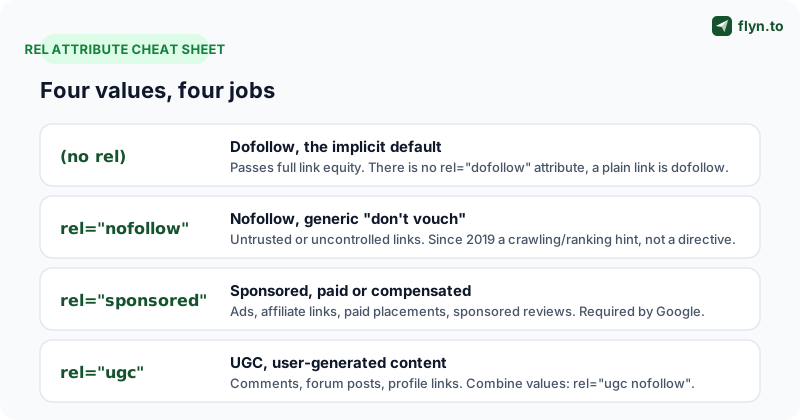
Before you can decide which value to apply where, you need each one's job crisp in your head. Here is the practical breakdown, what each value signals and the exact markup it uses.
 Tap to enlarge
Dofollow and nofollow, the original pair
Dofollow is the absence of any equity-blocking annotation. You write a normal <a href> and the link votes for its destination. Nofollow is the generic brake: rel="nofollow" tells Google you are not endorsing the target. It is the right value when a link is neither paid nor user-generated but you still want to stay neutral, a reference link to a site you do not fully trust, syndicated widget links, or press-release boilerplate. Quick rules of thumb:
- If you would happily put your reputation behind the link, keep it dofollow.
- If you are linking out only for the reader's convenience, not as an endorsement, use nofollow.
- Remember nofollow is now a hint, do not treat it as a hard "this will never be crawled" guarantee.
Sponsored and ugc, the 2019 additions
Sponsored (rel="sponsored") is mandatory for any link where compensation changed hands, money, free product, or services. UGC (rel="ugc") marks links your editorial team did not place: comments, forum posts, reviews, profile fields. The reason Google wants the specific value rather than blanket nofollow is honest signal, it can refine how it weighs different link types over time. Use them like this:
- sponsored, ads, affiliate links, paid guest posts, gifted-product reviews.
- ugc, anything submitted by a visitor rather than written by you.
- When in doubt between the two, ask: did money change hands (sponsored) or did a user write it (ugc)?
For a tool's-eye view of these values in the wild, run any page through the Link Extractor, it lists every <a href> and its rel attribute so you can see the real distribution rather than guessing.
When to Use NoFollow, Sponsored, and UGC
Knowing the values is easy. Knowing which to apply where is what separates a clean link profile from one that quietly invites a manual action. Here is the decision framework, link type by link type.
Use sponsored for anything paid, and ugc for anything user-placed
This is non-negotiable in Google's eyes. Any link where money, free product, or compensation changed hands must carry rel="sponsored" (or at minimum nofollow). Passing equity through a paid link is a link scheme under Google's spam policies and can trigger a manual penalty against both the linking and receiving site. Likewise, if a link was placed by a user rather than your editorial team, rel="ugc" is the honest label. Concretely:
- Affiliate links (Amazon Associates, ShareASale, etc.),
rel="sponsored", plus a visible FTC disclosure the reader can see. - Display and native ad units,
rel="sponsored". - Paid guest posts and gifted-product reviews,
rel="sponsored"on the brand links. - Blog comments, forum threads, user profiles,
rel="ugc"(most CMSs add this automatically, verify yours does).
If you run an affiliate site, paid and gifted links are the single highest-risk area of your link profile. The affiliate link tracking guide covers how to tag, cloak, and attribute affiliate links without tripping Google, and the Outbound Link Checker shows which of your outbound links currently lack a sponsored attribute.
When to keep links dofollow
Default to dofollow for every link that is editorial, unpaid, and points somewhere you genuinely trust. That means your internal links, your citations to authoritative sources, and your links to your own properties. Linking out to good sources with dofollow links is a positive relevance signal, Google's own guidance and decades of SEO testing agree that generous, relevant outbound linking helps rather than hurts. Use plain nofollow only as the catch-all for links that are neither paid nor user-generated but that you still do not want to endorse. The outbound link audit checklist walks through keeping that outbound profile healthy.
The instinct to nofollow every outbound link "to keep the equity" is the most expensive superstition in SEO. PageRank sculpting died in 2009. Hoarding link equity does not concentrate it, it just makes your site look stingy and unhelpful to the one algorithm you are trying to please.
Do NoFollow Backlinks Help SEO?
Everything above covers the links you publish. Flip the question around and you get the one link builders actually argue about: when another site links to you with a nofollow link, did you gain anything? The short answer: yes, just not direct ranking equity. Treating nofollow backlinks as worthless is as wrong as treating them like dofollow gold.
What a nofollow backlink still delivers
Four kinds of value survive the missing equity transfer, and each one compounds:
- Referral traffic. A nofollow link from a busy page sends real visitors who buy, subscribe, and share. The crawler attribute is invisible to humans. Put a tracked link behind it and you can see exactly what it delivers; our guide to tracking clicks on a link shows the setup.
- Discovery that turns into dofollow links. Journalists, bloggers, and curators find sources through nofollow channels (Reddit, X, newsletters) and then cite them editorially with clean dofollow links. The nofollow link is often the first domino.
- Profile naturalness. Real sites earn a healthy mix of both. A backlink profile that is suspiciously close to 100% dofollow looks engineered, because organically popular pages always pick up nofollow mentions from social platforms and forums along the way.
- A possible ranking hint. Since 2019, nofollow is a hint, not a directive. Google reserves the right to count a nofollow link when its systems judge the link genuine. You cannot rely on it, but the floor is no longer hard zero.
The dofollow-to-nofollow balance
There is no official ratio to hit, and anyone selling you "70/30" precision is inventing it. What matters is that both types exist in proportions that look like the natural consequence of being cited: for most sites that lands somewhere between 25% and 50% nofollow, simply because social platforms and UGC communities nofollow everything (see the platform table below). The practical rules: judge every backlink opportunity on relevance and traffic first, take high-quality nofollow links happily, and verify the ones you worked hardest for. A guest post is worth real effort only if the publication links out dofollow, which the DoFollow Link Checker confirms in one paste, including its bulk mode for vetting ten prospect articles at once.
And the backdrop question, do backlinks still matter in 2026: yes. Link signals remain one of the strongest ranking signal families Google uses, AI Overviews cite pages that rank, and every serious correlation study still puts quality links near the top. What changed is the margin for junk: low-quality link schemes get ignored or penalized faster than ever, which makes the boring advice (relevant links from real sites, attributes used honestly) the profitable advice.
Which Platforms NoFollow Your Links by Default
Most of the links the average creator or business shares do not live on their own site. They live in bios, posts, descriptions, and answers on platforms they do not control, and those platforms decide the rel attribute. Nearly all of them chose nofollow everything years ago to kill link spam. Here is how the major platforms treat your links today:
| Platform | Your links there | Worth knowing |
|---|---|---|
| NoFollow | Bio link only; caption URLs are not clickable at all | |
| X (Twitter) | NoFollow | Everything is wrapped in t.co redirects first |
| NoFollow | Applies to posts, pages, and profiles alike | |
| YouTube | NoFollow | Description and pinned-comment links included |
| TikTok | NoFollow | Bio link gated behind follower thresholds |
| NoFollow | Posts, articles, and profile fields | |
| NoFollow | Pin destination links | |
| NoFollow / UGC | Some links in established communities get followed over time | |
| Wikipedia | NoFollow | Every external citation, no exceptions |
| Medium | NoFollow | All external links in stories |
| Quora | NoFollow | Answer and profile links |
| GitHub | NoFollow | README and comment links get rel="nofollow" added |
The takeaway is liberating once it sinks in: stop chasing equity on platforms that structurally never pass it, and optimize those links for traffic instead. That means links people actually click, destinations that match the promise, and measurement so you know which platform earns its place. A branded short link with UTM parameters does all three jobs at once: build the parameters with the free UTM Builder, and if Instagram is a main channel, the Instagram link shortener covers the bio-link workflow end to end. Meanwhile, reserve your dofollow-earning effort for the places it can pay: editorial mentions, guest posts on dofollow-friendly publications, and resource pages.
NoOpener and NoReferrer Are Not SEO Attributes
Here is a confusion that costs people hours: the rel attribute holds both SEO values and security values, and they have nothing to do with each other. Mixing them up leads marketers to think a link is nofollow when it is not, or to "fix" SEO by touching attributes that have zero ranking effect.
What noopener and noreferrer actually do
rel="noopener" is a browser security attribute. When a link opens in a new tab via target="_blank", the new page can otherwise access the original page through the JavaScript window.opener object, a vector for tab-napping attacks. noopener severs that reference. Modern browsers now apply it automatically for target="_blank" links, but many CMSs still add it explicitly.
rel="noreferrer" strips the HTTP Referer header when a visitor follows the link, so the destination site cannot see which page sent the traffic. It is a privacy attribute. Its only SEO-adjacent side effect is on the receiving end: that site loses referral data and may see the visit as direct traffic in analytics. Neither attribute changes whether your link passes equity:
| rel value | Category | Affects SEO / link equity? | What it does |
|---|---|---|---|
nofollow | SEO | Yes, withholds ranking signal | Tells crawlers not to pass equity |
sponsored | SEO | Yes, withholds ranking signal | Marks a paid or compensated link |
ugc | SEO | Yes, withholds ranking signal | Marks user-generated content |
noopener | Security | No | Blocks window.opener access |
noreferrer | Privacy | No (only affects referral analytics) | Strips the Referer header |
A link with rel="noopener noreferrer" and no nofollow is still a fully dofollow link, it passes equity normally. Many WordPress sites add noopener noreferrer to every "open in new tab" link, and site owners wrongly assume those links are therefore "safe" nofollow links. They are not. If you needed those links to be nofollow or sponsored, you have to add that value explicitly.
What this means for your audits
When you audit a link for SEO, look only for nofollow, sponsored, and ugc. Treat noopener and noreferrer as background noise, present for good security and privacy reasons, irrelevant to whether equity flows. A page can be wall-to-wall noopener noreferrer links and still pass full equity through every one of them.
How to Audit the Links on Any Page
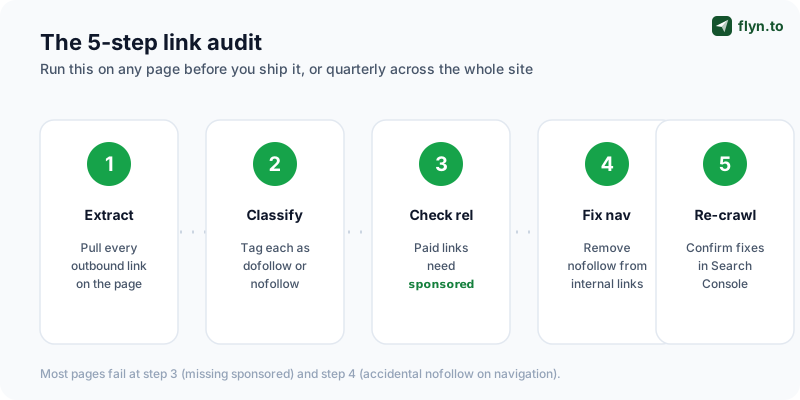
You cannot manage what you cannot see. Auditing a page's links, yours or a competitor's, takes minutes once you have a process. Here is the five-step workflow we recommend.
 Tap to enlarge
The five-step workflow
Run these steps in order on any URL you want to understand, your own key pages, or a competitor page you want to reverse-engineer:
- Extract every link. Pull a full list of the page's links and their
relvalues with the Link Extractor, so you are not eyeballing raw source code. - Classify dofollow vs nofollow. The DoFollow Link Checker isolates the links that pass equity; the NoFollow Link Checker isolates the ones that do not. Both support bulk mode, so you can sweep up to 10 URLs in one pass, and both flag page-level robots nofollow directives that silently nofollow every link on a page.
- Verify paid links carry sponsored. Cross-check the dofollow list against your ad units and affiliate links, every paid link in the dofollow bucket is a compliance risk. The Outbound Link Checker surfaces outbound links and their attributes.
- Review anchor text. Over-optimized, exact-match anchors are a Penguin risk; the Anchor Text Analyzer shows your distribution against safe ranges.
- Fix, then re-crawl. Remove stray internal nofollows and add
sponsoredwhere missing (the Rel Attribute Generator builds the exact tag), then request a recrawl in Google Search Console so updatedrelvalues are picked up.
Reading the results like an SEO
The classification is only step one, the value is in what you do with it. Pair the NoFollow Link Checker output with the anchor text distribution guide for the safe percentages, and use the Internal Link Checker to confirm your internal links all pass equity. Re-running the checkers after you deploy confirms the fix actually shipped.
When evaluating a backlink opportunity, a guest post, a directory, a resource page, check whether the target site's links are dofollow before you invest effort. Paste the page into the DoFollow Link Checker. If the site nofollows every outbound link, the backlink still has referral and brand value, but expect zero ranking lift, and price your effort accordingly.
Checking a single link manually in your browser
For a one-off check you do not need a tool at all. Right-click the link, choose Inspect (Cmd+Option+I on Mac, Ctrl+Shift+I on Windows), and read the highlighted <a> tag in the Elements panel. If its rel contains nofollow, sponsored, or ugc, the link withholds equity; if there is no rel at all, or only noopener/noreferrer, it is dofollow. To see a page the way crawlers first fetch it, prefix the address with view-source: and search the raw HTML. Manual inspection stops scaling past a handful of links, which is exactly when the checkers above earn their keep.
Fixing rel attributes in WordPress
WordPress core still has no nofollow toggle in the link dialog, so pick the route that fits your site. SEO plugins such as Rank Math, AIOSEO, and Yoast add per-link nofollow and sponsored checkboxes directly in the editor. Affiliate-link managers (ThirstyAffiliates, Pretty Links, Lasso) can apply rel="sponsored" globally to every affiliate link they manage, which is the fastest retrofit for an older site with thousands of bare links. For a one-off link, switch the block to "Edit as HTML" and paste the attribute yourself; the Rel Attribute Generator outputs the exact string. Comment links need no work at all: WordPress has tagged them rel="ugc nofollow" automatically since version 5.3.
Common NoFollow and DoFollow Mistakes
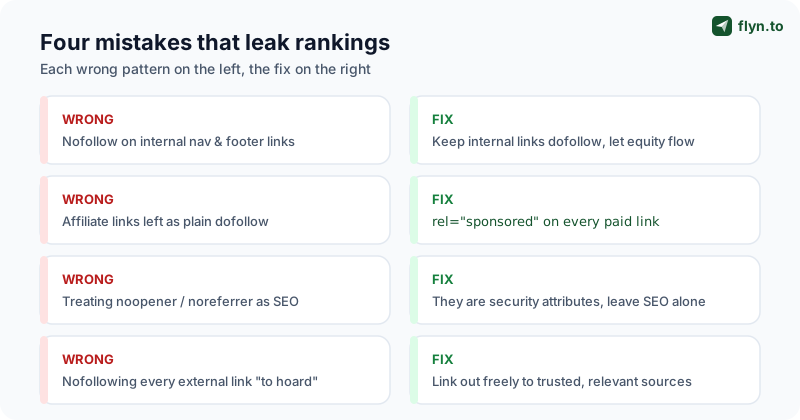
After auditing hundreds of sites, the same handful of errors show up everywhere. Each one quietly leaks rankings or invites a penalty. Here are the six to hunt down on your own site today.
 Tap to enlarge
The equity-leaking mistakes
These three errors throw away ranking value you have already earned:
- Nofollowing your own internal links. Some themes and plugins add
rel="nofollow"to navigation, footers, or related-post links. Because PageRank sculpting is dead, that equity is not redirected, it is destroyed. Every internal link should be dofollow. Crawl your site and strip every internal nofollow you find. - Nofollowing every outbound link. Hoarding equity by nofollowing all external links does not help you and signals a low-quality, unhelpful page. Link out to trusted, relevant sources with normal dofollow links, it is a positive signal.
- Treating nofollow as a noindex. Since 2019, nofollow does not reliably keep a page out of Google's index. If you genuinely need a URL excluded from search, use a
noindexmeta tag or robots rules, notrel="nofollow"on the links pointing to it.
The compliance and confusion mistakes
These three either invite a penalty or waste your time chasing the wrong attribute:
- Missing sponsored on affiliate and paid links. Affiliate links left as plain dofollow are a textbook link scheme. Many affiliate sites built before 2019 still have thousands of bare affiliate links, retrofit
rel="sponsored"across all of them. Most affiliate plugins now have a global setting for this. - Confusing security attributes with SEO. Assuming
noopenerornoreferrermakes a link "nofollow." It does not. Audit fornofollow,sponsored, andugcspecifically, and ignore the security values. - Ignoring how shared short links behave. Branded short links posted inside comments or forums are usually nofollowed or ugc-tagged, fine for traffic, but no SEO equity. And if a short link gets flagged as spam, even the referral value disappears.
Fixing these six is the highest-ROI link-hygiene work most sites can do. Use a clean branded domain and monitor link health so your shared links keep working, see Flyn's plans for branded-domain link management, or browse the full set of free SEO tools to audit every page as you go.
Frequently Asked Questions
Is there really no rel="dofollow" attribute?
rel="dofollow" does not exist in the HTML specification and never has. "Dofollow" is informal SEO shorthand for a normal link with no rel annotation that changes how search engines treat it. Every plain <a href> tag is already a dofollow link by default. If someone tells you to "add a dofollow attribute," what they actually mean is "leave the link alone, do not add nofollow, sponsored, or ugc." Adding the literal text rel="dofollow" does nothing harmful, but it also does nothing useful, search engines simply ignore the unrecognized value.Do nofollow links help SEO at all?
What is the difference between rel="nofollow" and rel="sponsored"?
rel="sponsored" specifically marks a link that is paid or compensated, ads, affiliate links, sponsored posts. rel="nofollow" is the generic "I do not vouch for this" value for untrusted or unverifiable links that are not paid. Google explicitly asks you to use sponsored for paid links. Using plain nofollow on a paid link is acceptable as a fallback, but using neither, leaving a paid link dofollow, is a link-scheme violation.Did Google really make nofollow optional in 2019?
nofollow from a strict directive to a hint, effective March 2019 for ranking and September 2019 for crawling. Before the change, Google guaranteed it would never crawl or pass equity through a nofollowed link. After the change, Google reserves the right to crawl a nofollowed URL and even use it for ranking if its systems decide that is appropriate. In day-to-day practice Google still honors most nofollow links as "no equity," but the hard guarantee is gone. The practical consequence: never rely on nofollow to keep a page out of the search index.Should internal links ever be nofollow?
noindex page or robots rule is the cleaner solution. Audit your site and remove every internal nofollow you find.How do I check if a link is nofollow or dofollow?
<a> tag, if you see rel="nofollow", rel="sponsored", or rel="ugc", it does not pass equity; if there is no rel attribute (or only noopener/noreferrer), it is a dofollow link. The Outbound Link Checker does the same across all outbound links at once.Do affiliate links need rel="sponsored" or rel="nofollow"?
rel="sponsored", it is Google's recommended value for affiliate links because affiliate links are compensated placements. rel="nofollow" is accepted as a fallback and still keeps you compliant, since Google treats both as hints to not pass equity. What you must not do is leave affiliate links as plain dofollow: that passes ranking credit through a paid link, which violates Google's link-scheme policy and can trigger a manual penalty. Most affiliate plugins now offer a one-click global setting to apply sponsored to every affiliate link. The affiliate link tracking guide covers the full setup.Does nofollow affect the noopener or noreferrer attributes?
nofollow is an SEO value that controls whether link equity passes. noopener is a security attribute that prevents the destination page from accessing the original tab via window.opener. noreferrer is a privacy attribute that strips the Referer header so the destination cannot see the source page. A link can carry any combination of these, and they do not interact. Crucially, a link with rel="noopener noreferrer" but no nofollow is still a fully dofollow link that passes equity normally, a point many WordPress users get wrong because their CMS adds noopener noreferrer to new-tab links automatically.What is the difference between a nofollow link and a nofollow meta tag?
rel="nofollow" on an individual <a> tag nofollows that one link. A nofollow inside the page's meta robots tag (<meta name="robots" content="nofollow">) or in the X-Robots-Tag HTTP header nofollows every link on the page at once, even links whose own markup looks perfectly clean. This is the sneakiest false positive in backlink valuation: a "dofollow" placement on a page with a page-level nofollow directive passes nothing. Per-link audits alone cannot catch it, which is why the NoFollow Link Checker reads the meta robots tag and X-Robots-Tag header on every check and warns you when a page-wide nofollow is in force.What is a healthy ratio of dofollow to nofollow backlinks?
Free tools for this
Three Flyn tools that pair well with the strategy in this article, all free, no signup needed.
Open Graph Checker
Preview how URLs unfurl on social.
Meta Tag Generator
Generate full SEO meta tags.
Anchor Text Analyzer
Audit anchor text distribution.
Keep reading
Three related deep-dives from the Flyn blog.

Disclose Affiliate Links: rel=sponsored & FTC
11 min read

Internal Linking SEO Strategy: Best Practices
14 min read

How to Audit Outbound Links: 9-Point SEO Checklist
13 min read
Ready to try Flyn?
Free plan includes 25 links/month, full analytics, and access to all 30+ free tools above. No credit card required.
Already a member? Log in
Karan Bhakuni is the founder of Flyn. He writes about branded links, click analytics, and the link-management tooling growth teams and creators actually need, drawn from building Flyn and reading a lot of user feedback.
Find these guides useful? Add Flyn as a preferred source so more of them show up in your Google results.