Free Anchor Text Analyzer
Audit anchor text distribution on any page. Classify anchors as exact, partial, branded, generic, or naked URL, with over-optimization risk scoring.
Want to track anchor text clicks?
Flyn short links give you per-link click analytics, see which anchor text variants actually drive traffic on pages you control.
How to Analyze Anchor Text in 3 Steps
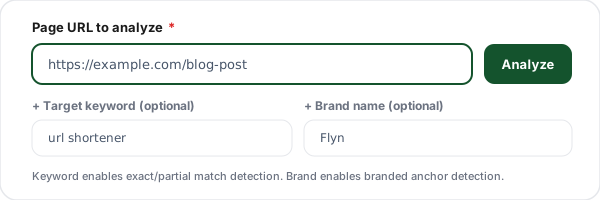
Enter URL + optional keyword
Paste the URL you want to audit. Optionally add a target keyword so the tool can flag exact-match and partial-match anchors correctly. Without a keyword, the tool uses general classification rules.
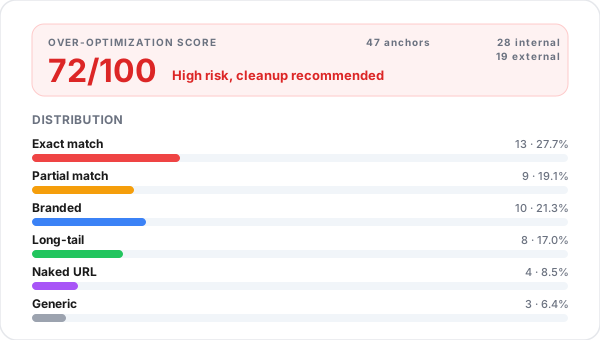
Review the distribution
See every anchor classified into 7 types (exact, partial, branded, generic, naked URL, image, long-tail) with percentages and an over-optimization score (0-100). Warnings flag suspicious patterns like 30%+ exact match or 10+ identical anchors.
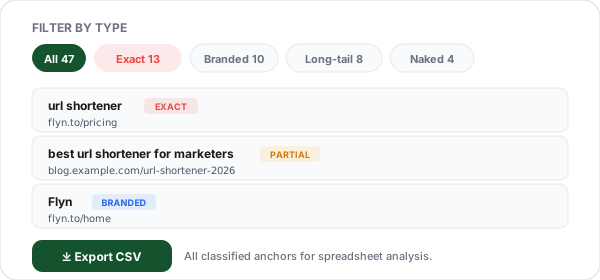
Filter and export
Click any type in the distribution chart to filter the anchor list. Sort by frequency, internal vs external, or nofollow status. Export the full classified data as CSV for Google Sheets, SEO client reports, or manual review.
What is Anchor Text?
Anchor text is the visible, clickable text inside a hyperlink. In <a href="example.com">click here</a>, the anchor text is "click here". It's simultaneously a usability signal (what users see before clicking) and one of Google's strongest ranking inputs, search engines treat the words inside an anchor as a vote for what the destination page is about.
The ranking weight of anchor text comes with a catch: it's the easiest ranking signal to manipulate. Between 2005 and 2012, link-builders bought thousands of backlinks with exact-match keyword anchors to rank pages for competitive terms. Google's Penguin algorithm update in 2012 began penalizing pages whose anchor profiles looked artificially keyword-stuffed. Today, over-optimized anchors can demote rankings instead of boosting them.
This tool classifies every anchor on a page into seven categories, exact match, partial match, branded, naked URL, generic, image, and long-tail, and scores the page's anchor distribution for over-optimization risk. Healthy pages have diverse anchor profiles: branded, naked URLs, descriptive long-tail, and only 5-10% exact match. Pages where 30%+ of anchors use the same target keyword look like paid link campaigns and trigger Penguin review.
Use this tool for two jobs: auditing your own pages (are internal anchors descriptive enough? Are you over-optimizing around a target keyword?) and analyzing competitors (which anchors do high-ranking pages use for keywords you want?). Combine with Outbound Link Checker for a full link-audit view, and with Link Extractor for CSV export of all links on a page.
Anchor Text Types Reference
The 7 categories this tool classifies every anchor into, with risk thresholds and healthy percentages for editorial pages.
| Type | Example | Risk | Notes |
|---|---|---|---|
| Exact match | "url shortener" | HIGH if >20% | Anchor equals target keyword exactly. Highest ranking signal but also highest spam risk. Keep under 10% on editorial pages. |
| Partial match | "best url shortener 2026" | Medium if >25% | Contains keyword + other words. Looks more natural than exact match. Healthy at 15-25%. |
| Branded | "Flyn" | None | Contains brand name. Safest anchor type, nobody pays for branded links. Homepages often 50-60% branded. |
| Naked URL | https://flyn.to | None | The URL itself is the clickable text. Looks natural for citations. Healthy at 20-30%. |
| Generic | "click here" | None (SEO-neutral) | Non-descriptive phrases. No ranking signal to destination. 10-15% is normal on content pages. |
| Image | Image with alt text | Low | Link wraps <img>. Google uses alt text as anchor signal. Ensure alt text is descriptive. |
| Long-tail | "how to shorten marketing URLs" | None | Multi-word descriptive phrases. Best mix of relevance and naturalness. Aim for 15-25%. |
Over-Optimization Warning Signs
These patterns trigger the tool's over-optimization score. Seeing multiple on one page is a red flag that needs cleanup before the next Penguin refresh.
30%+ exact-match
Natural pages rarely exceed 10% exact match. 30%+ strongly suggests paid or automated link building and triggers Google Penguin review.
Identical anchors on 10+ links
When the same exact phrase anchors 10+ different links to one URL, it looks scripted. Rewrite to vary the wording.
Zero generic/branded anchors
Natural pages always have some "click here" and brand-name anchors. Their absence suggests every link was optimized for keywords, a spam signal.
All anchors same length
Organic anchors have wildly varying length (2 to 15 words). If every anchor is exactly 2-3 keywords long, it looks templated.
Brand not in top 10 anchors
On your own pages, the brand name should appear frequently in anchors. If it's not in the top 10, you're either under-branding or over-optimizing around keywords.
High exact match on external only
If internal anchors look natural but external (incoming backlinks) are 40% exact-match, that's a paid-link signal. Audit backlinks in Google Search Console.
Why Use Flyn's Analyzer?
7-type classification
Every anchor categorized as exact / partial / branded / generic / naked / image / long-tail with keyword matching.
Over-optimization score
Aggregate 0-100 risk score based on exact-match ratio, anchor repetition, and distribution balance.
Stateless + private
URLs are fetched once, analyzed, returned. No logging, no persistence, safe for client audits.
CSV export
Full classified anchor list for Google Sheets, client reports, or manual QA. Up to 300 anchors per page.
Frequently Asked Questions
What is anchor text?
Anchor text is the visible, clickable text inside a hyperlink. In <a href="example.com">click here</a>, the anchor text is "click here". Search engines use anchor text to understand what the destination page is about. It's one of the strongest signals Google has for ranking the target URL. Well-chosen anchor text boosts the destination's rankings; spammy or manipulative anchors can trigger penalties.
Why does anchor text distribution matter for SEO?
Google's algorithm evaluates whether a page's anchor text distribution looks natural (earned editorially) or artificial (manipulated for rankings). A healthy page has a diverse anchor mix: branded, naked URLs, generic, long-tail descriptive, and only a small percentage of exact-match phrases. Pages where 40%+ of anchors are exact-match keyword phrases look like paid link campaigns and risk Penguin algorithm demotion or manual review.
What are the different types of anchor text?
Seven common types: (1) Exact match, anchor equals the target keyword ("url shortener"). (2) Partial match, contains keyword plus other words ("best url shortener 2026"). (3) Branded, contains the brand ("Flyn"). (4) Naked URL, the URL itself ("https://flyn.to"). (5) Generic, non-descriptive ("click here", "read more", "link"). (6) Image, link wraps an image (alt text used if available). (7) Long-tail, descriptive multi-word anchors ("how to shorten URLs for marketing campaigns").
What is exact-match anchor text and why is it risky?
Exact-match anchor text is when the anchor exactly matches a target keyword the destination page is trying to rank for. Example: a page targeting "url shortener" gets backlinks with the anchor "url shortener". Up to 2010, this was the strongest ranking signal. Sites gamed it by buying exact-match anchors in bulk. Google's Penguin update (2012 onward) penalized this manipulation. Today, natural sites have <5% exact-match anchors; anything over 20% looks suspicious.
What is over-optimization and how do I avoid it?
Over-optimization is when too many anchors on your page (or pointing to your page) use the same keyword or close variants. Common signs: 30%+ exact-match anchors, repetitive keyword stuffing across anchors, identical anchor text on 10+ different links to the same URL. Fix by diversifying: mix branded, naked URL, generic, and descriptive anchors. Aim for 5-10% exact match maximum on editorial pages.
What's a healthy anchor text distribution?
As a rough guide for content pages: 30-40% branded, 20-30% naked URL, 15-25% long-tail descriptive, 10-15% generic, 5-10% exact match, 5-10% partial match. Homepages and category pages skew more branded (50-60%). E-commerce product pages skew more exact/partial match (20-30%) since customers search by product name. The "right" distribution depends on page type, industry, and competition, our tool flags pages that deviate sharply from natural patterns.
How do I fix over-optimized anchor text?
Four strategies: (1) Rewrite anchors to use the brand name or URL instead of the keyword. (2) Convert exact-match to long-tail ("url shortener" → "how to shorten URLs for marketing"). (3) Remove redundant links, if the same destination has 5 exact-match links on your page, keep one and delete the rest. (4) Add rel="nofollow" to paid/sponsored exact-match anchors. Re-audit monthly with this tool to verify your anchor distribution moved into the healthy range.
Are naked URLs bad for SEO?
No, naked URLs ("https://example.com" as clickable anchor text) are one of the safest, most natural anchor types. They carry less ranking signal than descriptive anchors but they never look manipulative. A page with 20-30% naked URLs in its anchor mix signals natural linking. Use naked URLs especially for citations, references, and low-priority links where you don't want to spend keyword equity.
Does anchor text affect the destination page's rankings?
Yes, anchor text on external links TO a page is one of the top 20 ranking factors per leaked algorithm documents. Anchor text on internal links also matters, though less than external. When multiple sites link to your page with relevant descriptive anchors, Google treats that as a strong relevance signal. But manipulative anchor text (paid exact-match) can trigger Penguin and hurt rankings instead.
What counts as "generic" anchor text?
Generic anchors are non-descriptive short phrases that tell search engines nothing about the destination. Common examples: "click here", "here", "this", "link", "read more", "learn more", "more info", "check it out", "website", "page". These are user-friendly but SEO-neutral. Aim to mix generic anchors (10-15%) with descriptive ones, too many generic anchors means you're leaving ranking signals on the table.
Should internal and external anchor text be different?
Internal anchors (within your site) can be more descriptive and keyword-focused, you control both ends of the link, and Google understands this. External anchors (links from other sites to yours) should look organic and varied because they're supposed to be editorial. When auditing, use this tool to filter by internal vs external, heavy exact-match internal is fine (you're telling visitors and Google what each page is about); heavy exact-match external looks like link-building manipulation.
Does this tool store the URLs I check?
No. All analysis happens in a stateless API route that never logs or persists URLs. The source URL is fetched once, anchors are parsed, distribution is calculated, and the result is returned, nothing is stored on our servers. The optional history feature saves results to your browser's localStorage only. Safe to audit private staging sites, pre-launch pages, or client domains confidentially.
Related Tools
Anchor text and rel attributes work together: the nofollow vs dofollow guide covers when a paid anchor must carry rel="sponsored". Auditing internal anchors? Check that each one points at the canonical address as well, the free Canonical URL Checker spots anchors that land on a non-canonical duplicate of the page they mean to boost.
Outbound Link Checker
Audit external links on any page, rel attributes, tabnabbing risks, unique domains.
Internal Link Checker
Find orphan pages, audit link depth, and check internal linking across your whole site.
DoFollow Link Checker
Find every dofollow link on any page, spot equity leaks and link-building targets.
Link Extractor
Extract every link from any page with anchor text, rel attributes, and CSV export.
Ready to level up your links?
Audit anchor distribution, then wrap your most important CTAs in Flyn short links, get per-link click data to see which anchor text actually drives traffic.