Free Outbound Link Checker
Audit every external link on any page. See anchor text, rel attributes (nofollow/sponsored/ugc), target=_blank security issues, and unique domains, instantly.
Want to cloak outbound links for tracking?
Flyn short links wrap any destination URL in a branded tracking link, perfect for affiliate, sponsored, or cross-promotional outbound links.
How to Audit Outbound Links in 3 Steps
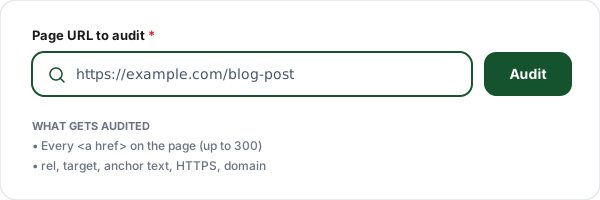
Enter any URL
Paste the URL of the page you want to audit. The tool fetches the HTML server-side, parses every <a> tag, and extracts full rel + target + anchor metadata, up to 200 links per page.
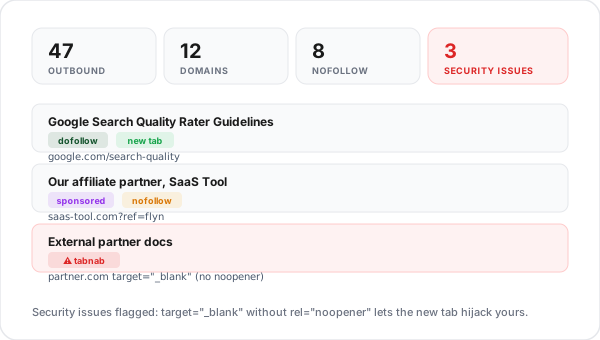
Review outbound links
See every external link with anchor text, rel attributes (nofollow/sponsored/ugc), target attribute, and flagged tabnabbing risks (target=_blank without noopener). Summary cards show nofollow/dofollow split, unique domains, and security issues at a glance.
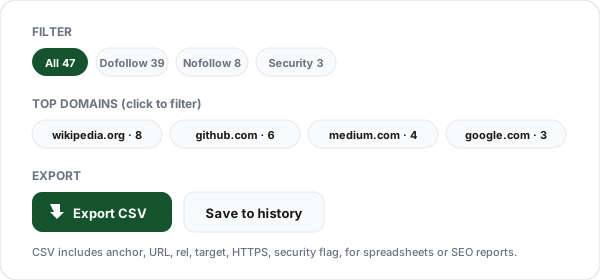
Filter and export
Filter by domain, nofollow status, sponsored/ugc markers, or security issues. Click a domain to see all links to that destination. Export the full audit as CSV for spreadsheets, SEO reports, or sharing with your team.
What is an Outbound Link?
An outbound link (sometimes called an external link) is a hyperlink from your page to a different domain. If example.com links to wikipedia.org, that's outbound. Every webpage ships outbound links, references, citations, product pages, social profiles, affiliate links, and together they form the link neighborhood Google uses to evaluate your content's credibility.
The quality of your outbound links matters more than the quantity. A handful of links to authoritative sources (government sites, Wikipedia, major publications, original research papers) tells search engines your content is well-researched. A page linking heavily to low-quality or off-topic sites gets flagged as spammy. The algorithm assumes you're part of the same "bad neighborhood."
Outbound links also carry security implications. The target="_blank" attribute opens links in a new tab, but without rel="noopener", the destination page can hijack your original tab via JavaScript (a tabnabbing attack). Modern browsers default to noopener behavior, but older codebases and HTML emails remain vulnerable. Our tool flags every unprotected target="_blank" so you can retrofit.
Finally, outbound links decay. Studies consistently find 10-15% of external links break within a year, and roughly half break within a decade. Linkrot silently erodes user experience, wastes crawl budget on dead ends, and signals to Google that the content isn't maintained. Quarterly audits, paste each of your top pages into this tool, spot-check the broken ones, keep your outbound link graph healthy. For replacements, the Wayback Machine is your friend.
rel Attribute Reference
Google uses rel attributes on outbound links to decide whether to pass link equity and how to interpret the relationship. Our tool parses every rel value on every outbound link.
| rel value | SEO effect | When to use |
|---|---|---|
| nofollow | Does not pass link equity | Untrusted links, user-generated content, paid placements (legacy) |
| sponsored | Does not pass link equity | Paid or affiliate links (required by Google since 2019) |
| ugc | Does not pass link equity | Forum posts, blog comments, any user-generated link |
| noopener | No SEO impact | Security, prevents tabnabbing via window.opener on target=_blank |
| noreferrer | No SEO impact | Security + privacy, also strips Referer header on click |
| external | No SEO impact | Semantic hint that link leaves the site (rarely used) |
| (none / dofollow) | Passes full link equity | Default, use for trusted editorial references |
Outbound Link Best Practices
Link to authorities, not peers
Wikipedia, government sites, major publications, original research, and topic-specific experts. These boost trust signals; linking to competitors or low-quality sites does the opposite.
Add rel="sponsored" to affiliate links
FTC + Google both require disclosure of paid placements. rel="sponsored" (or "nofollow sponsored") signals this to crawlers. Our tool flags every sponsored link so you can verify coverage.
Always pair target="_blank" with rel="noopener"
Without noopener, the linked page can hijack your tab via window.opener (tabnabbing). Modern browsers default to noopener, but older codebases are vulnerable. The tool flags every unprotected target="_blank".
Audit outbound links quarterly
Studies show 10-15% of external links break per year. Run this check every 3 months on your top 50 pages, replace dead links with Wayback snapshots or working alternatives.
Descriptive anchor text beats "click here"
Google uses anchor text to understand what the destination is about. "Google's Search Quality Rater Guidelines" is better than "this document". Avoid exact-match anchors that look over-optimized.
Fewer than 100 outbound links per page
Google can handle more but link equity gets diluted. For blog posts, 2-5 per 1,000 words is the sweet spot. If you find yourself linking to 30+ external sites, consider consolidating or splitting the content.
Why Use Flyn's Outbound Checker?
Security issue detection
Flags every target="_blank" without rel="noopener", prevents tabnabbing on your site.
Unique domain grouping
Click any domain to see every outbound link to that destination. Catches over-linking and affiliate concentration.
rel attribute audit
Parses nofollow, sponsored, ugc, noopener, noreferrer, external, verify FTC compliance on affiliate links.
Export to CSV
Download the full audit for spreadsheet analysis, SEO reports, or client deliverables.
Frequently Asked Questions
What is an outbound link?
An outbound link (also called an external link) is a hyperlink from your page to a different domain. If example.com links to wikipedia.org, that's an outbound link. Outbound links are the opposite of internal links (same-domain) and different from backlinks (which are pages linking TO you). Every outbound link passes a small amount of link equity to the destination unless you mark it rel="nofollow" or similar.
How do outbound links affect SEO?
Outbound links to authoritative, topically relevant sources boost your page's credibility and can improve rankings. Google's algorithm treats well-referenced content as higher quality. However, too many outbound links (especially to low-quality or irrelevant sites), broken external links, or links to spam sites will hurt rankings. Aim for a balance: 2-5 high-quality outbound links per 1,000 words of content is a healthy ratio.
What is linkrot and why does it matter?
Linkrot is when outbound links on your pages become broken over time because the destination site was moved, deleted, or went offline. Studies show roughly 10-15% of external links break within a year, and 50% within 10 years. Broken outbound links hurt user experience (dead ends), waste crawl budget, and signal to Google that your content isn't maintained. Audit outbound links quarterly and replace or remove dead ones.
What do rel="nofollow", "sponsored", and "ugc" mean?
These rel attributes tell Google how to treat the outbound link. rel="nofollow" tells crawlers not to pass link equity (use for untrusted links). rel="sponsored" marks paid or affiliate links, required by Google since 2019 to disclose paid placements. rel="ugc" marks User Generated Content (forum posts, comments). You can combine: rel="nofollow ugc" for forum comment links. Unmarked (dofollow) links pass full equity, use these for editorial references.
Should I link to external sites at all?
Yes, outbound links to authoritative sources are a trust signal to Google and users. Wikipedia, government sites, major publications, and topic-relevant experts improve your content's credibility. Avoid: pages with low authority, irrelevant topics, spam or ad-farm sites, paywalled content, or anything that might redirect users away permanently. A good rule: link outbound when the reference genuinely helps the reader.
How many outbound links are too many?
There's no hard cap, but Google has historically recommended keeping outbound links to a "reasonable number", typically under 100 per page. Beyond that, individual links start passing minimal link equity. For SEO-focused pages (blog posts, guides), aim for 2-5 outbound links per 1,000 words pointing to high-authority references. Excessive outbound linking can look spammy and trigger manual review.
What's the security issue with target="_blank" without rel="noopener"?
When you open a link with target="_blank" (new tab), the new page can use JavaScript's window.opener to modify your original page, a vulnerability called "tabnabbing" where a malicious site can redirect your tab to a phishing page. Adding rel="noopener" (or noreferrer) breaks this window.opener reference. Modern browsers now default to noopener on target="_blank", but older codebases and email clients may still be vulnerable. Our checker flags every unprotected target="_blank".
How do I fix broken outbound links?
Four options in order of preference: (1) Replace, find a live alternative on the same topic, ideally from the same author or publisher. (2) Archive, swap the dead URL for a Wayback Machine snapshot (web.archive.org/web/*/original-url). (3) Remove, delete the link entirely if no replacement exists. (4) Redirect, if the destination now redirects elsewhere, update to the final URL. Re-run this tool monthly to catch new linkrot before users do.
Can outbound links hurt my rankings?
Yes, if they point to low-quality sites. Google's algorithm evaluates the "neighborhood" your content links to, pages that link heavily to spam, PBNs (private blog networks), or penalized sites get treated as complicit. Stick to authoritative sources. If you find yourself linking to a site that has since turned into spam (domain expired and re-registered), use this tool to find and remove those links.
Do I need to disclose paid or sponsored outbound links?
Yes, both legally and for SEO. The FTC requires clear disclosure of material connections (paid partnerships, affiliate links, sponsored content). Google requires rel="sponsored" on paid links since 2019; violation risks manual penalties. Visible on-page disclosure ("affiliate link" text) plus rel="sponsored" in the HTML is the safest combo. Our tool flags every sponsored/ugc rel attribute so you can verify coverage.
What's good anchor text for outbound links?
Descriptive and topical. "According to Smashing Magazine's guide on CSS Grid" is better than "click here" or the raw URL. Google uses outbound anchor text to understand what the destination page is about and to evaluate your content's topical authority. Avoid generic phrases ("read more", "link"), over-optimized exact-match anchors (suggests manipulation), and repeated identical anchors (suggests automation).
Does this tool store the URLs I check?
No. All link extraction happens in a stateless API route that never logs or persists URLs. Your source URL is fetched once, parsed for outbound links, and the result is returned, nothing is stored on our servers. The optional history feature saves results to your browser's localStorage only. Safe to audit private staging sites, unreleased pages, or anything confidential.
Related Tools
Spotted outbound links missing nofollow or sponsored? The nofollow vs dofollow guide explains exactly which rel value each link needs.
NoFollow Link Checker
Audit every rel="nofollow", sponsored, and UGC link on any page, color-coded, CSV export.
Internal Link Checker
Find orphan pages, audit link depth, and check internal linking across your whole site.
Anchor Text Analyzer
Audit anchor text distribution and detect over-optimization risk on any page.
Link Extractor
Extract every link from any page with anchor text, rel attributes, and CSV export.
Ready to level up your links?
Audit outbound links to spot linkrot, then wrap your own outbound links in Flyn short links: every click counted free, with country and device breakdowns on Pro, so you see which external references actually drive traffic back.